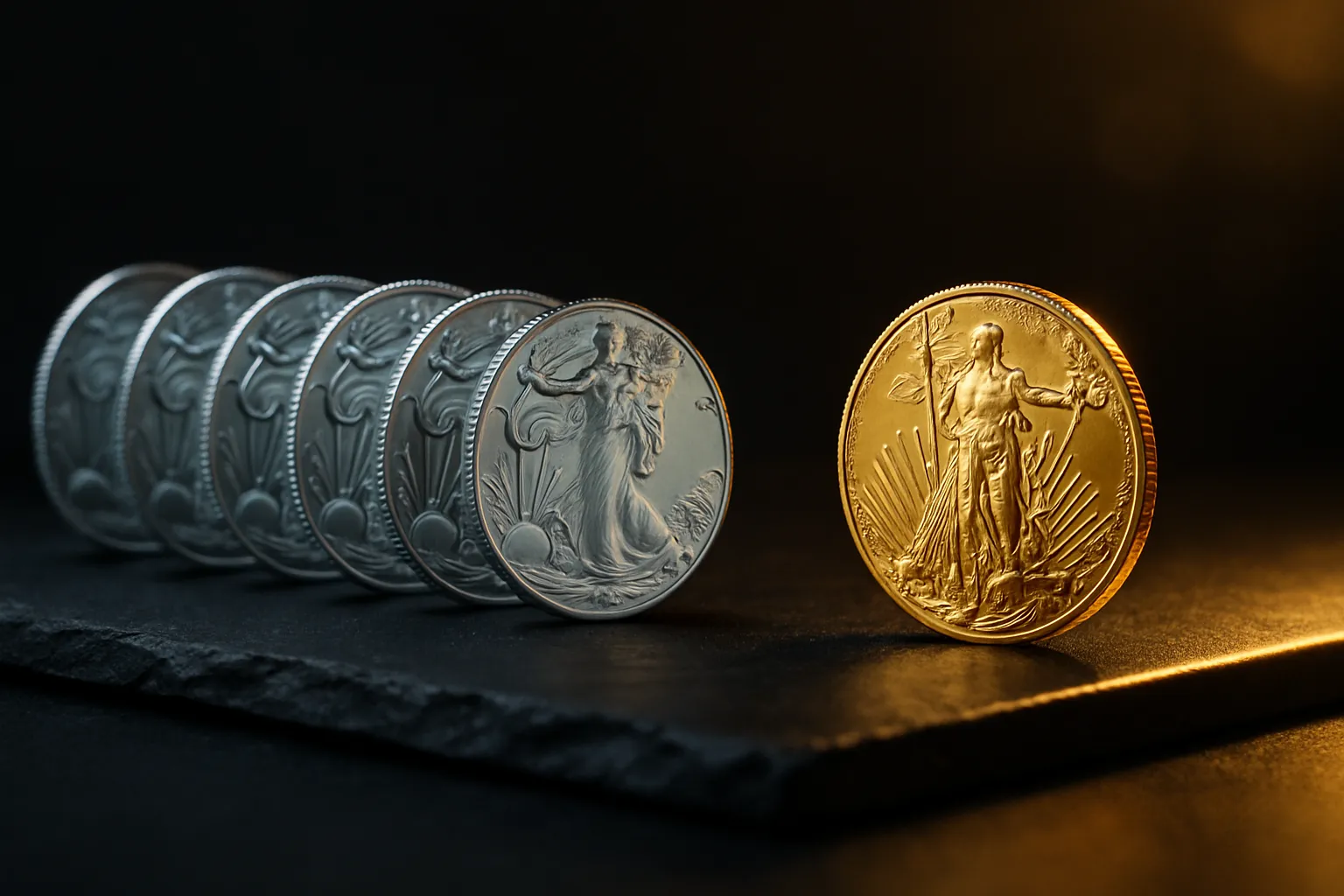
Most bullion guides — including our own — tell you to avoid fractional gold. On pure cost-per-ounce grounds that advice is correct and I'm not going to soften it. But it's also incomplete, because there are four situations where a tenth-ounce coin is genuinely the right purchase, and one of them is a tax argument almost nobody makes properly.
First, the honest cost
Fractional coins cost more per ounce because the cost of striking, packaging and distributing a coin barely changes with its size. Spread that fixed cost over a tenth of the metal and it becomes a much bigger share of the price.
| Size | Typical 2026 premium |
|---|---|
| 1 oz | ~3–7% |
| 1/2 oz | ~5–9% |
| 1/4 oz | ~7–12% |
| 1/10 oz | ~8–15% (up to 25% in tight markets) |
| 1/20 oz | ~15–25%+ |
What that costs in actual gold
Take a $5,000 budget with gold around $4,400 an ounce:
- 1 oz coins at 5%: $4,620 each → you get about 1.08 oz
- 1/10 oz at 12%: $492.80 each → ten coins = 1.00 oz for $4,928
- 1/20 oz at 20%: $264 each → eighteen coins = 0.90 oz for $4,752
Going fractional at a tenth costs you roughly 8% of your gold. At a twentieth, about 17%. If your only goal is accumulating ounces, buy the ounce.
And the hidden second cost
Buyback spreads on fractionals are wider too. Dealers typically bid 1–3% below spot on 1 oz bullion, and further below on small coins — so the round trip is worse than the headline premium implies. Before buying, ask your dealer what they'd pay you today for the exact coin. That gap is your real cost, and on small sizes it's often 10–20% versus 5–8% on an ounce.
So when are they actually worth it?
1. Divisibility
The strongest practical argument. If you need to raise $400, selling a tenth-ounce coin does it. Selling a full ounce forces you out of a position you wanted to keep, at whatever the price is that day. This is the mirror image of the kilo bar problem — the cheapest gold per ounce is also the least flexible.
2. Small budgets and regular buying
A tenth-ounce coin lets someone buy government-minted gold monthly rather than saving for a year to afford a single ounce. You pay for that access in premium, but "expensive gold now" beats "cheap gold eventually" if the alternative is not buying at all.
3. Gifting and barter
Sovereigns and tenth-ounce coins are the natural gift denominations. And in any scenario where you're actually transacting with metal, a one-ounce coin is too large a unit — you can't make change.
4. The UK tax argument — done properly
Here's where most guides go wrong. You'll read that fractionals let UK investors "sell in tranches to stay under the annual CGT allowance."
For Britannias and Sovereigns, that argument is unnecessary — they're UK legal tender and therefore completely exempt from Capital Gains Tax in every denomination, fractional included. The gain isn't counted at all, so it never touches your £3,000 annual allowance. Buy fractional Britannias or Sovereigns and the CGT question simply disappears.
The tranche argument does apply — and is genuinely useful — for non-exempt gold: bars, Krugerrands, Maples, Eagles. There, holding fractional sizes lets you realise gains in slices that stay under the annual exempt amount across multiple tax years. That's a real strategy, just not the one usually described.
The Sovereign: the original fractional
Specs unchanged since 1817 — 7.98805 g gross, 22 carat, 7.32 g (0.2354 oz) of fine gold, 22.05 mm across, £1 face value.
It's arguably still the most practical small gold coin ever made. A natural ~1/5 oz unit that predates modern fractional sizes; a 22-carat alloy that's harder and more wear-resistant than .9999 fine gold, so it survives handling; an enormous circulating supply worldwide giving deep liquidity and tight spreads; and instant recognition by dealers anywhere. Plus CGT-free in the UK. Pre-owned Sovereigns often trade below current-year premiums, which softens the fractional penalty considerably.
Half-Sovereigns (3.99 g, ~0.1177 oz) extend the ladder down with the same exemption.
The rule of thumb
Buy fractional gold for what it lets you do — sell small, gift, start small, transact — not for the metal. Build the core of a position in one-ounce coins or bars, then add fractionals deliberately for flexibility. A sensible mix might be 80% one-ounce and above, 20% fractional.
And if you're a UK buyer, make the fractional portion Sovereigns or Britannias. You get the flexibility and the tax exemption, which makes the premium far easier to justify.
Buying fractional gold with crypto
Bitgolder stocks fractional coins across the range — Sovereigns, half-Sovereigns, fractional Britannias, Maples and Krugerrands — priced live against spot with a transparent premium and no card fees. Note our minimum order applies, so fractionals work best bought several at a time. Everything ships fully insured and unmarked, payable in Bitcoin, Monero, stablecoins and 30+ coins. See how it works, or read proof vs bullion before you buy anything with a big premium attached.
Frequently asked questions
Are fractional gold coins worth it?
They are worth it for divisibility, gifting, small-budget accumulation and emergency liquidity — not for maximising ounces. You pay meaningfully more per ounce, so buy them for what they let you do rather than for the metal.
Why are small gold coins more expensive?
Because striking, packaging and distributing a coin costs roughly the same regardless of size. Spread that fixed cost over a tenth or a twentieth of the metal and it becomes a far larger share of the price.
Is it better to buy 1 oz or fractional gold?
For pure accumulation, 1 oz — you get more gold for the same money and a tighter buyback spread. On a $5,000 budget, buying tenth-ounce coins instead of ounces costs you roughly 8% of your gold.
What is the best fractional gold coin?
For UK buyers the gold Sovereign — 0.2354 oz of fine gold, 22 carat so hard-wearing, globally liquid and completely CGT-exempt. Elsewhere, 1/4 oz and 1/10 oz Krugerrands, Eagles and Maples are the most liquid choices.
Are fractional Britannias and Sovereigns CGT free?
Yes. Because they are UK legal tender, every denomination including fractionals is completely exempt from Capital Gains Tax for UK residents — the gain is not counted at all, so it never uses your annual allowance.
What is the smallest gold coin?
Among mainstream sovereign-mint issues, the 1/20 oz (about 1.55 g) Britannia and Krugerrand, with the 1/50 oz Krugerrand and various 0.5 g and 1 g coins going smaller. Premiums on these are the highest of any format.
Ready to buy gold with crypto?
Browse 400+ LBMA-certified coins and bars, priced live and shipped fully insured.
Shop the vault