Why Silver Costs More Than Gold in Europe: VAT, the Margin Scheme, and What to Do About It
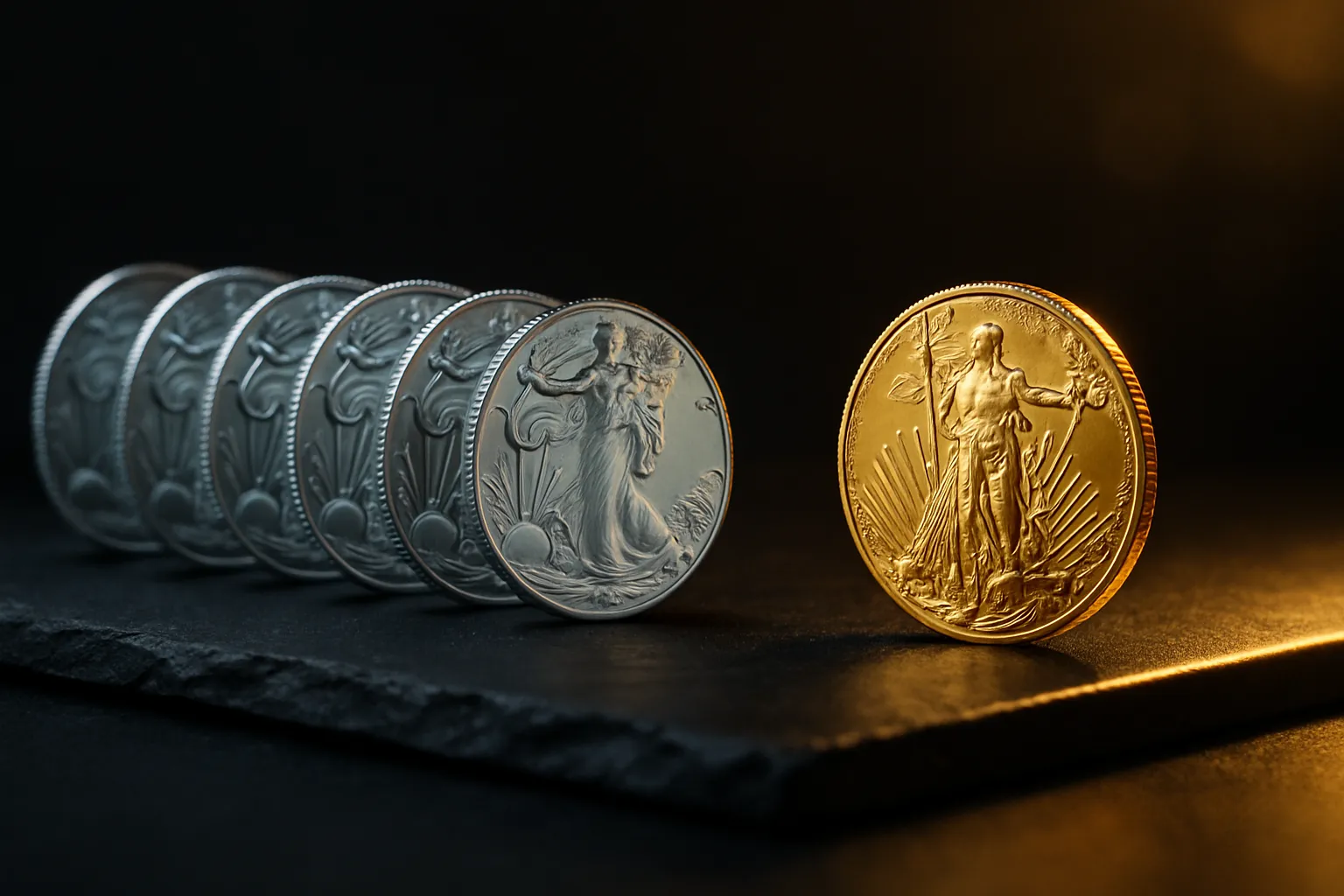
European buyers notice it immediately. Gold is priced tightly against spot. Silver, from the same dealer, on the same day, carries a markup that looks indefensible by comparison.
It usually isn't the dealer. It's VAT. Investment gold is exempt across the UK and EU. Silver is not — and on a metal where the premium is already a larger share of a small unit price, adding a standard-rate consumption tax on top changes the arithmetic completely.
Here is why the exemption exists, why silver was left out, and how European buyers actually deal with it.
The rule in one paragraph
Investment gold is exempt from VAT throughout the UK and the European Union. Silver, platinum and palladium are taxed at each country's standard rate. The exemption comes from the EU VAT Directive's special scheme for investment gold, retained in UK law after Brexit. It treats qualifying gold as a financial asset rather than a consumer good — you do not pay consumption tax for moving savings from one form into another.
To qualify, gold must be either a bar or wafer of at least 995 fineness in a market-accepted weight, or a coin of at least 900 fineness, minted after 1800, that is or was legal tender in its country of origin and sells at a modest margin over its metal content. Britannias, Krugerrands, Maple Leafs and standard accredited bars all qualify.
Silver meets none of this, because no equivalent scheme was ever written for it.
Why silver was left out
The reasoning is historical rather than principled. When the investment gold exemption was designed, the argument was that gold functioned primarily as a monetary and reserve asset — central banks hold it, it is traded as a financial instrument, and taxing it as consumption would put European dealers at an impossible disadvantage against jurisdictions that did not.
Silver was classified differently: an industrial metal with an investment sideline. Most silver produced each year is consumed by industry — electronics, solar, brazing, medical — rather than held as savings. That classification stuck, and it is why a metal that many people buy for exactly the same reason they buy gold gets taxed like a kettle.
Whether that still makes sense in 2026 is a fair argument. It is not, however, an argument you can have with a dealer's checkout.
The margin scheme — the part most buyers miss
Some European dealers can sell certain silver coins under a margin scheme, where VAT is charged only on the dealer's profit margin rather than the full sale price. The effect is a substantially lower tax cost than the headline rate implies.
The mechanics matter:
- It applies to coins that qualify as collectors' items or second-hand goods under the relevant scheme, not to freshly imported investment bars.
- The dealer cannot show VAT separately on the invoice, because it is levied on their margin, not on your purchase.
- That means a VAT-registered business cannot reclaim it — a real trade-off if you are buying through a company.
- Availability varies by member state and by product, and rules have been tightened over the years.
This is why two European dealers can quote noticeably different prices for the same silver coin: one may be selling margin-scheme stock, the other fully taxed. When you compare quotes, compare the tax basis, not just the number.
What this means in practice
Standard VAT rates across Europe generally sit in the high teens to low twenties as a percentage, varying by country. Applied to silver, that has three practical consequences:
- Silver needs a much larger move to break even. If you pay a fifth of the purchase price in tax that you will never recover on resale, silver has to appreciate meaningfully before you are level. Gold does not carry that hurdle.
- The gold-silver ratio is misleading for European buyers. The published ratio compares untaxed spot prices. Your real, after-tax entry ratio is worse — and any strategy built on the headline number needs adjusting. We cover the ratio itself in silver vs gold for crypto investors.
- Small silver purchases are hit hardest. Premium is already a bigger proportion of a $67 ounce than a $4,504 one; tax compounds it.
At the prices on our live feed as this was written — gold $4,504.10 and silver $67.44 per troy ounce — the gap in tax treatment is worth more than every premium difference between dealers combined.
The legitimate ways European buyers handle it
Buy gold instead
Blunt, and the most common answer. If the goal is to convert savings into metal, the exemption makes gold structurally cheaper to enter and exit in Europe. This is the main reason European stacks skew gold-heavy compared with American ones.
Bonded or freeport storage
Silver held in a customs-bonded warehouse or free port — Zurich, Geneva, Luxembourg, Singapore — is treated as not yet imported, so VAT is deferred for as long as it stays there. Take delivery at home and the VAT becomes payable. This is a genuine, legal, widely used arrangement, and it is a tax-deferral question rather than a secrecy one. The trade-off is that you no longer physically hold the metal, which for many buyers defeats the purpose. We compare storage models in gold bullion storage: what it costs and what's actually insured.
Buy margin-scheme coins where available
Where a dealer offers qualifying silver coins under the margin scheme, the effective tax cost is lower than the headline rate. Ask explicitly which basis applies before comparing prices.
What not to do
Ordering silver from outside the EU or UK in the hope it slips through without import VAT is not a strategy — it is a bet that customs will not open the parcel, and it makes you the importer of record when they do. Splitting orders to stay under thresholds is a separate offence from the tax itself. Our guide to customs and import duty on bullion covers what actually happens at the border.
Where silver still makes sense
None of this makes silver a bad asset. It makes it a taxed one, in one region, which is a different claim.
Silver remains the cheapest entry point into physical metal, it has genuine industrial demand underneath the investment case, and it is far more divisible for anyone thinking about small transactions rather than a store of value. Buyers outside the EU and UK face none of this and should largely ignore this article. And for European buyers who want silver specifically rather than metal generally, the tax is a cost of entry to price in — not a reason to abandon the position.
What it does mean is that the honest comparison for a European buyer is not "gold versus silver at spot." It is gold at spot versus silver at spot plus VAT, and that comparison looks quite different from the one the charts show.
You can buy silver with crypto from us in coins and bars, priced live. If you are buying into an EU or UK address and want the tax position on a specific order confirmed before you commit, ask us.
This is general information, not tax advice. VAT rates, thresholds and margin-scheme eligibility differ by country and change over time — confirm the current position for your own jurisdiction before making a decision.
Ready to buy gold with crypto?
Browse 400+ LBMA-certified coins and bars, priced live and shipped fully insured.
Shop the vault