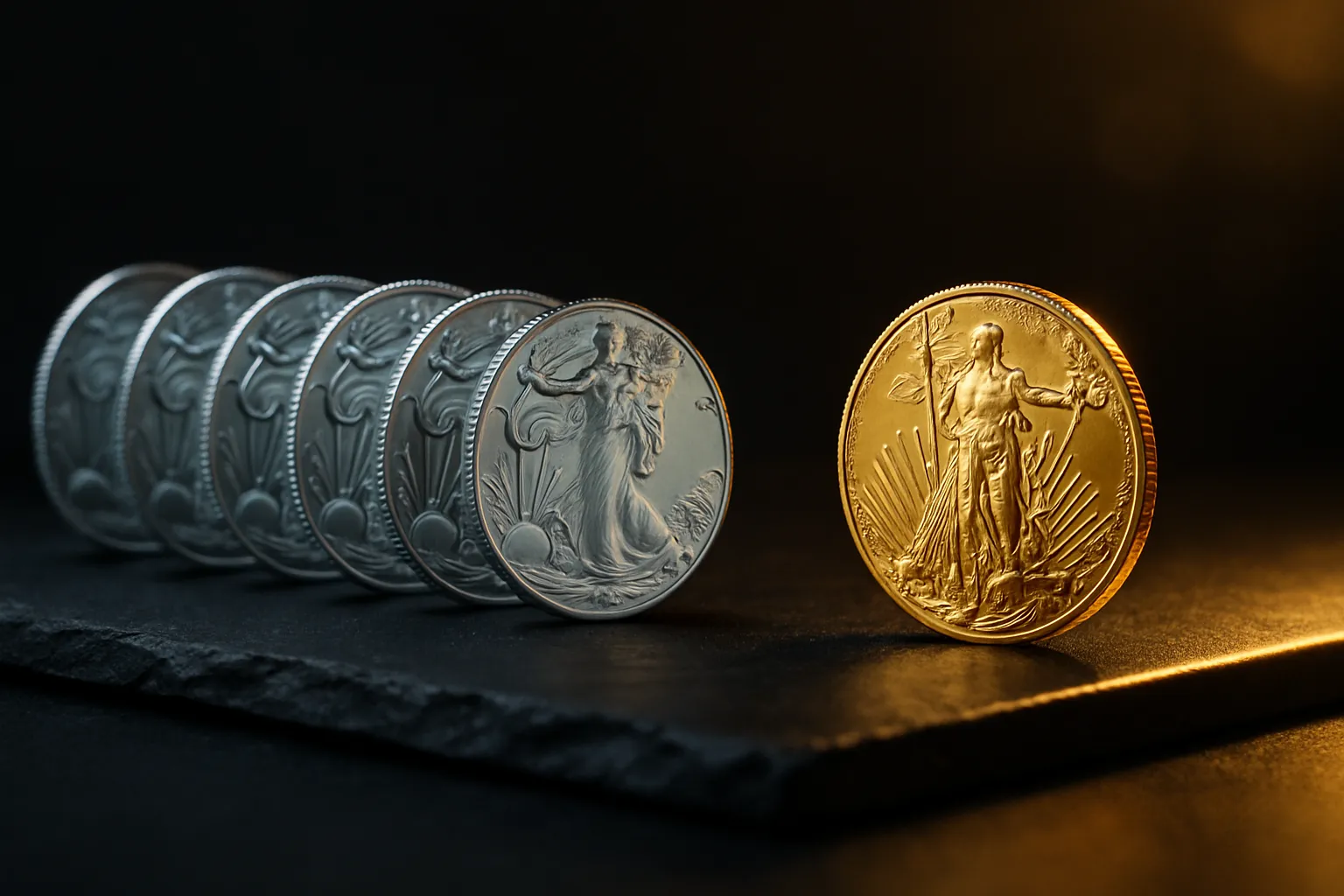

Coins or bars? It's the first real decision most people face after they've decided to buy physical gold, and the internet is full of confident, contradictory answers. The truth is calmer: an ounce of gold is an ounce of gold, whether it's stamped into a Krugerrand or poured into a bar. Both track the same spot price. What actually differs is cost, flexibility and how easily you'll sell later — and which of those matters depends entirely on you. Here's the honest comparison for 2026.
Premium: bars are cheaper per ounce
Bars win on price, and it's not close at the top end. Bars skip the elaborate minting, the legal-tender status and the collector demand that push coin premiums up, so they cost less over spot — and the bigger the bar, the lower the premium. Rough 2026 ranges (they move daily):
| Format | Typical premium over spot |
|---|---|
| 1 kilo / 100 g cast bar | ~1–2% |
| 1 oz minted bar | ~2–4% |
| 1 oz low-premium coin (Krugerrand, Philharmonic) | ~3–6% |
| 1 oz higher-premium coin (Eagle, Britannia) | ~4–8% |
| Fractional coins & small bars | ~8–20%+ |
If cost-per-ounce were the only factor, everyone would buy kilo bars and stop reading. It isn't — which is the whole point of this article. For a deeper look at squeezing premiums down, see the cheapest way to buy gold in 2026.
Divisibility and liquidity: coins win
This is where coins earn their keep. A coin is the most liquid retail unit of gold there is. It's legal tender, instantly recognised, and — crucially — you can sell one at a time. Need to raise a little cash? Sell two coins and keep the rest. A one-kilo bar is all-or-nothing: to unlock any value you have to sell the whole thing and find a single buyer with six figures ready. In a hurry, that pool of buyers is a lot thinner than the pool for a Maple Leaf or Krugerrand.
Recognition and authentication
Sovereign coins carry a government's guarantee of weight and purity, and dealers worldwide recognise them on sight — a Maple Leaf even has scannable anti-counterfeit "DNA" built in. Bars lean on documentation instead. A minted bar from a name like PAMP, Valcambi, Metalor or Credit Suisse usually comes sealed in a tamper-evident assay card with a serial number, which makes it easy to resell at value. A cast bar is cheaper and has a certain rustic appeal, but with fewer built-in security features it may need an assay check before a dealer buys it back. Counterfeiting is real on both sides — our guide on spotting a fake bar explains why buying sealed product from a reputable dealer is the real protection.
Storage
Bars store more value in less space. Gold is dense to begin with, and a bar packs it into a compact, stackable form with no capsules or tubes. If you're holding a large amount and space (or a safe deposit box) is tight, bars are the efficient choice. For modest holdings the difference is trivial.
Selling later: the spread
When you sell, you meet the dealer's buy price, and the gap between their buy and sell is the spread — your real round-trip cost. Large recognised bars have the tightest spreads at scale; recognised sovereign coins are close behind and far easier to sell in part. Obscure or unsealed cast bars tend to have the widest spreads because the buyer has to price in verification. Recognisability, again, is what keeps more money in your pocket at exit. Whichever you choose, our 7-day buyback repurchases at live spot.
Tax (UK and EU)
- VAT: all investment-grade gold — bars and coins — is VAT-free in the UK and EU. (Silver is different; that's covered in our gold-and-silver pieces.)
- UK Capital Gains Tax: here the format matters enormously. Only UK legal-tender coins — Britannias and Sovereigns — are CGT-free. Bars, and foreign coins like the Maple, Krugerrand and Eagle, are not exempt. For a UK resident planning a big position, that can be the deciding factor: CGT-free Britannias may beat a marginally cheaper bar once you account for the exit.
Outside the UK, rules vary by country — check your own. This is general information, not tax advice.
So which should you buy?
Lean coins if you're working with a smaller or regular budget, you value the ability to sell piece by piece, you might gift some, you want maximum liquidity, or you're a UK resident who wants CGT-free Britannias or Sovereigns.
Lean bars if you're deploying a larger lump sum, you want the lowest possible cost per ounce, and compact storage matters more to you than divisibility.
The answer most people land on: both
You don't have to pick a side. A common, sensible setup is a bar or two as the low-cost core of the position — the cheapest ounces you can get — plus a stack of recognised 1 oz coins for flexibility, so you can sell a little without breaking a big bar. Frequent traders skew toward coins; long-horizon stackers skew toward bars; most people end up somewhere in the middle, and that's fine.
Buying either with crypto
At Bitgolder you can buy coins and bars with Bitcoin, Monero, stablecoins and more, priced live against the spot price with a transparent premium and no card fees. Mix and match in one order, put account credit toward part of it and pay the rest in crypto, and lock your USD total at checkout so a market move during confirmation doesn't change the bill. Everything ships insured and discreet. New here? The how-it-works page walks through it, and if you're still choosing coins, our Maple Leaf and Philharmonic reviews are a good place to start.
Frequently asked questions
Should I buy gold coins or bars?
Both hold the same metal value. Buy coins for divisibility, liquidity, gifting and — in the UK — CGT-free Britannias and Sovereigns. Buy bars for the lowest premium per ounce, large lump sums and compact storage.
Are gold bars cheaper than coins?
Yes, per ounce. Bars carry lower premiums over spot because of lower manufacturing costs and no collector value, and larger bars are the cheapest way to own gold by weight.
Are gold coins easier to sell than bars?
Generally yes. Coins are more liquid — they are legal tender, globally recognised, and can be sold one at a time. A large bar is all-or-nothing and needs a single bigger buyer.
Are gold bars harder to sell?
Large bars need a bigger single buyer, and cast or obscure bars may need an assay check before a dealer buys them back. Small minted bars sealed in assay cards with serial numbers resell easily.
Do gold bars hold their value?
Yes. A bar's value tracks the gold spot price closely with little premium above the metal. Recognised-refiner bars such as PAMP or Valcambi with assay cards are easiest to reverify and resell at value.
Do I pay tax buying physical gold in the UK?
There is no VAT on any investment gold, bars or coins. Capital Gains Tax applies to bars and foreign coins on sale, but Royal Mint legal-tender coins — the Britannia and Sovereign — are CGT-free.
Ready to buy gold with crypto?
Browse 400+ LBMA-certified coins and bars, priced live and shipped fully insured.
Shop the vault