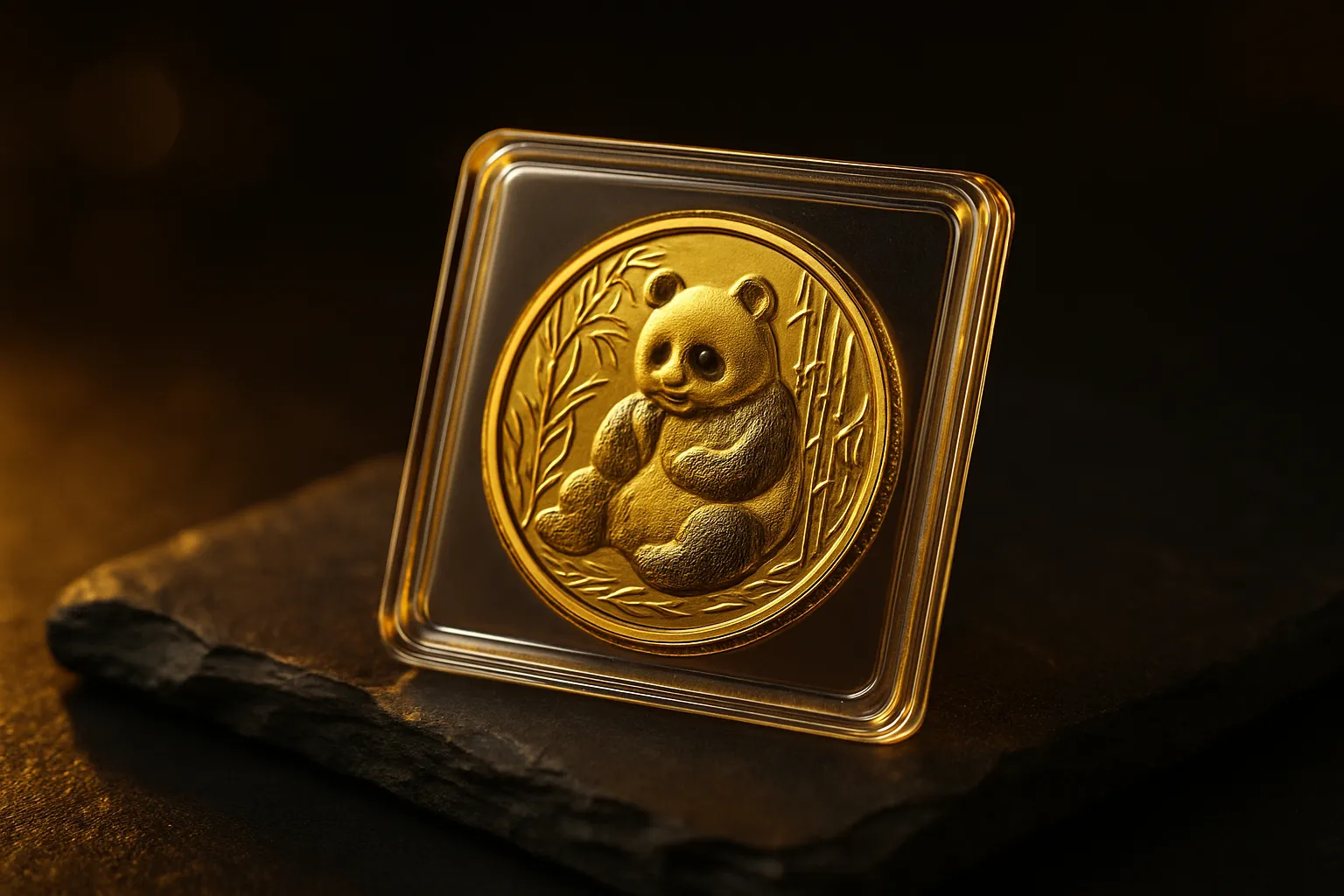
The Chinese Gold Panda is the only major bullion coin that redesigns itself every year, and the only one that quietly stopped being an ounce. Both facts matter enormously when you're comparing prices, and both catch buyers out. Here's the honest 2026 review.
The thing nobody tells you first: it isn't one ounce
In 2016 China abandoned troy-ounce denominations and moved the entire Panda series to metric weights. The flagship coin is now 30 grams — 0.9645 troy oz, roughly 3.5% less gold than a 1 oz coin.
That single detail invalidates most casual price comparisons. If you're weighing a Panda against a Krugerrand or a Maple, compare per gram, not per "ounce", or you'll systematically overpay. Pre-2016 Pandas are true one-ounce coins; always check the date.
| Size | Face value | Replaced |
|---|---|---|
| 30 g | ¥500 | 1 oz |
| 15 g | ¥200 | 1/2 oz |
| 8 g | ¥100 | 1/4 oz |
| 3 g | ¥50 | 1/10 oz |
| 1 g | ¥10 | 1/20 oz |
Issued by the People's Bank of China, produced by China Gold Coin Corporation, struck at the Shenyang, Shenzhen and Nanjing mints. Purity is .999 fine. The 30 g measures 32 mm across and 2.7 mm thick with a reeded edge — useful numbers, because a fake with the right weight but the wrong dimensions is the classic tungsten tell.
The design changes every single year
This is the series' entire identity. Where the Maple Leaf, Krugerrand, Eagle and Britannia keep one perennial design, the Panda reverse is redrawn annually — a new panda scene every year since 1982.
There's exactly one exception: 2002 repeated the 2001 design. The public objection was loud enough that the mint committed to a new design every year thereafter, and has kept to it since. That episode is why collectors treat the 2001/2002 pair as an oddity.
The obverse never changes: the Hall of Prayer for Good Harvests at Beijing's Temple of Heaven. No monarch, no portrait — unusual among world bullion coins.
The practical consequence is that every year is effectively its own limited series, so Pandas trade semi-numismatically rather than as pure bullion.
What you'll pay
A new sealed 2026 30 g Panda typically runs 4–9% over spot, against roughly 2–5% for a Krugerrand or Maple. Small sizes are brutal: 1 g coins routinely carry 25–50%+ premiums, because the minting cost is nearly the same regardless of how little gold is inside.
You're paying that extra 2–4 points for three things: the annual design change, published mintage caps, and genuine collector demand — especially domestically in China. For 2026, confirmed caps include 500,000 for the 1 g and 200,000 for the 15 g.
Some years do appreciate above melt. Low-mintage dates, early-1980s issues and pristine sealed examples regularly command real premiums. But that cuts both ways: buy the current year at a high premium and you may only realise bullion value on exit unless that particular date becomes scarce. If your goal is maximum metal per dollar, our cheapest way to buy gold guide points elsewhere.
Two things that will cost you money
Never break the seal. Pandas ship in a heat-sealed China Mint sleeve. That seal is the coin's provenance, its anti-counterfeit feature and its evidence of never having been handled. Opening it is the single most expensive thing you can do — dealers reckon on an immediate loss of around 20% of the premium, and a de-sealed Panda is often bid at plain bullion value.
Milk spots. Pandas are among the coins most associated with milk spotting — cloudy white blemishes that surface on the field, generally attributed to residues from the blanking and washing process. They're cosmetic and no gold is lost, but they destroy grading potential and collector premium. Far worse on silver Pandas than gold, though gold isn't immune. Another reason to keep coins sealed and stored dry.
Liquidity and fakes
In Asia, Panda liquidity is exceptional — it's the reference gold coin across mainland China, Hong Kong and Singapore, with deep two-way markets. In the West it's good but a tier below the Krugerrand, Maple and Eagle: every major dealer buys them, but spreads are wider and some smaller shops will price them as generic gold rather than paying a collector premium. The premium you pay isn't always the premium you get back.
Pandas are also among the more heavily counterfeited gold coins, precisely because of that premium and the sealed-sleeve convention — fakes come in fake sleeves. Buy sealed, buy from a dealer with a buyback, and check weight, diameter and thickness. Our guide on spotting fake bullion covers the tests that actually work.
Tax
- VAT: VAT-free investment gold in the UK and EU.
- UK CGT: not exempt. Pandas are Chinese legal tender, not UK legal tender, so gains above the annual allowance are chargeable.
For a UK investor building size, a Sovereign or Britannia at a lower premium and zero CGT is the more efficient core holding. Pandas make more sense as a collector or diversification position than as the base of a UK stack. General information, not tax advice.
Who it's for
Buy a Panda if you want gold that's also genuinely beautiful and collectable, you value the annual-series angle, or you have exposure to Asian resale markets. Look elsewhere if you're optimising purely for grams per dollar, or you're a UK taxpayer building a large position.
Bitgolder stocks Panda coins alongside the rest of the gold range, payable in Bitcoin, Monero, stablecoins and 30+ other coins at a transparent premium over live spot. Coins ship sealed, fully insured and discreetly. If you're still choosing, compare against the Maple Leaf, Philharmonic and Krugerrand.
Frequently asked questions
Is a gold Panda 1 oz?
Not since 2016. China moved the series to metric weights, so the flagship coin is 30 grams — 0.9645 troy oz, about 3.5% less gold than a 1 oz coin. Pre-2016 Pandas are true one-ounce coins, so always check the date and compare per gram.
Are gold Pandas a good investment?
They are genuine investment-grade gold with a collector premium attached. The gold is as good as any coin, but you pay roughly 4–9% over spot versus 2–5% for a Krugerrand. Good for a blend of bullion and collectability, expensive as pure gold exposure.
Why do Panda designs change every year?
It has been deliberate policy since 1982 — a new panda scene each year makes every date a distinct collectible. The only lapse was 2002 reusing the 2001 design, and the public backlash cemented the annual-change rule.
Do gold Pandas have milk spots?
They can. Milk spotting — cloudy white blemishes attributed to residues from the blanking and washing process — is a known issue across the Panda series and worse on silver. It is cosmetic and costs no gold, but it destroys grading and collector value.
Are Panda coins worth more than melt value?
Usually yes. Current-year sealed coins trade a few percent above melt, and low-mintage or early-1980s dates can trade far above. But a de-sealed, spotted or common-date coin may fetch little more than bullion value.
Should you open the sealed packaging on a gold Panda?
No. The heat-sealed China Mint sleeve is the coin's provenance and anti-counterfeit feature. Dealers reckon breaking it costs around 20% of the premium immediately, and a de-sealed Panda is often bid at plain bullion value.
Ready to buy gold with crypto?
Browse 400+ LBMA-certified coins and bars, priced live and shipped fully insured.
Shop the vault