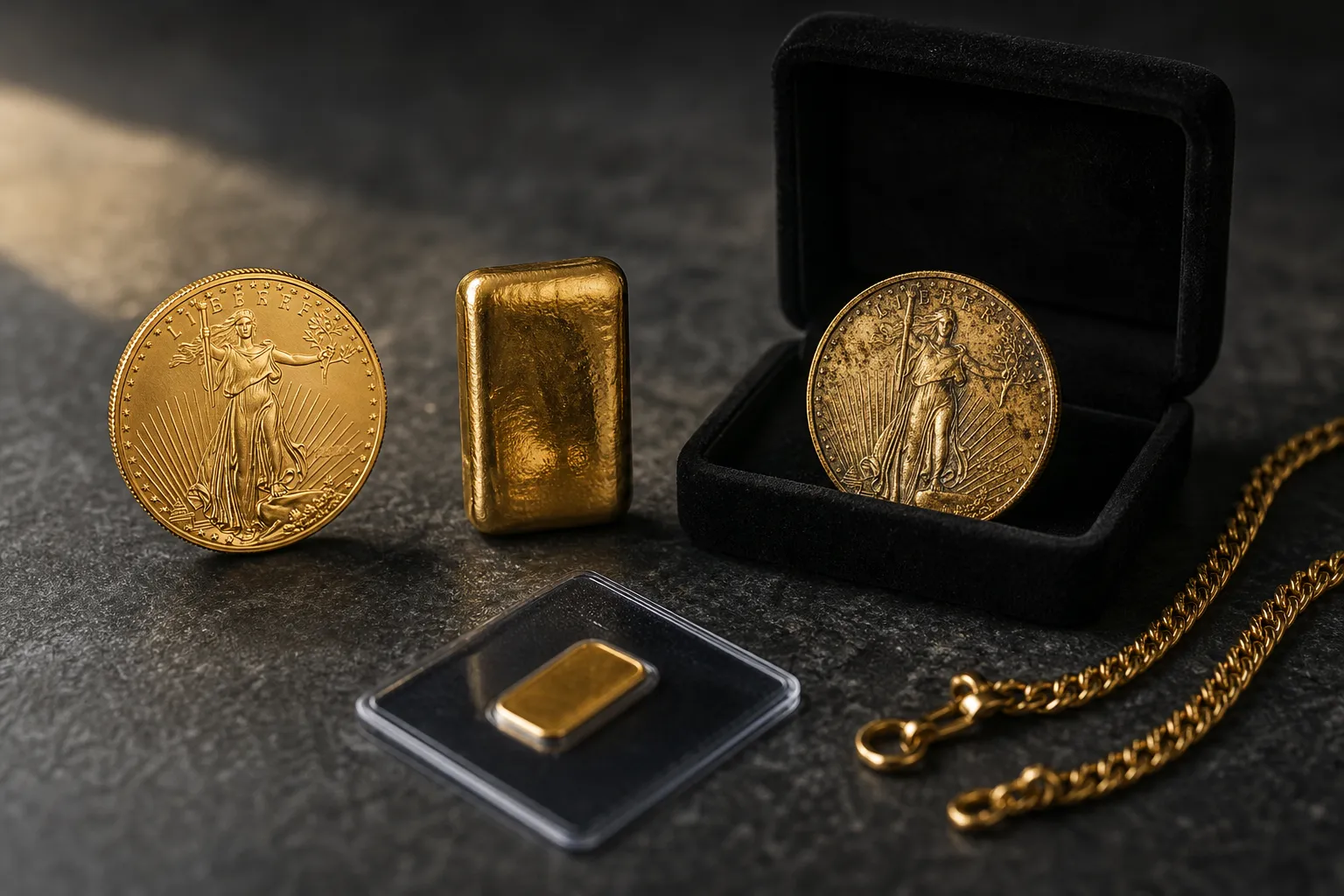
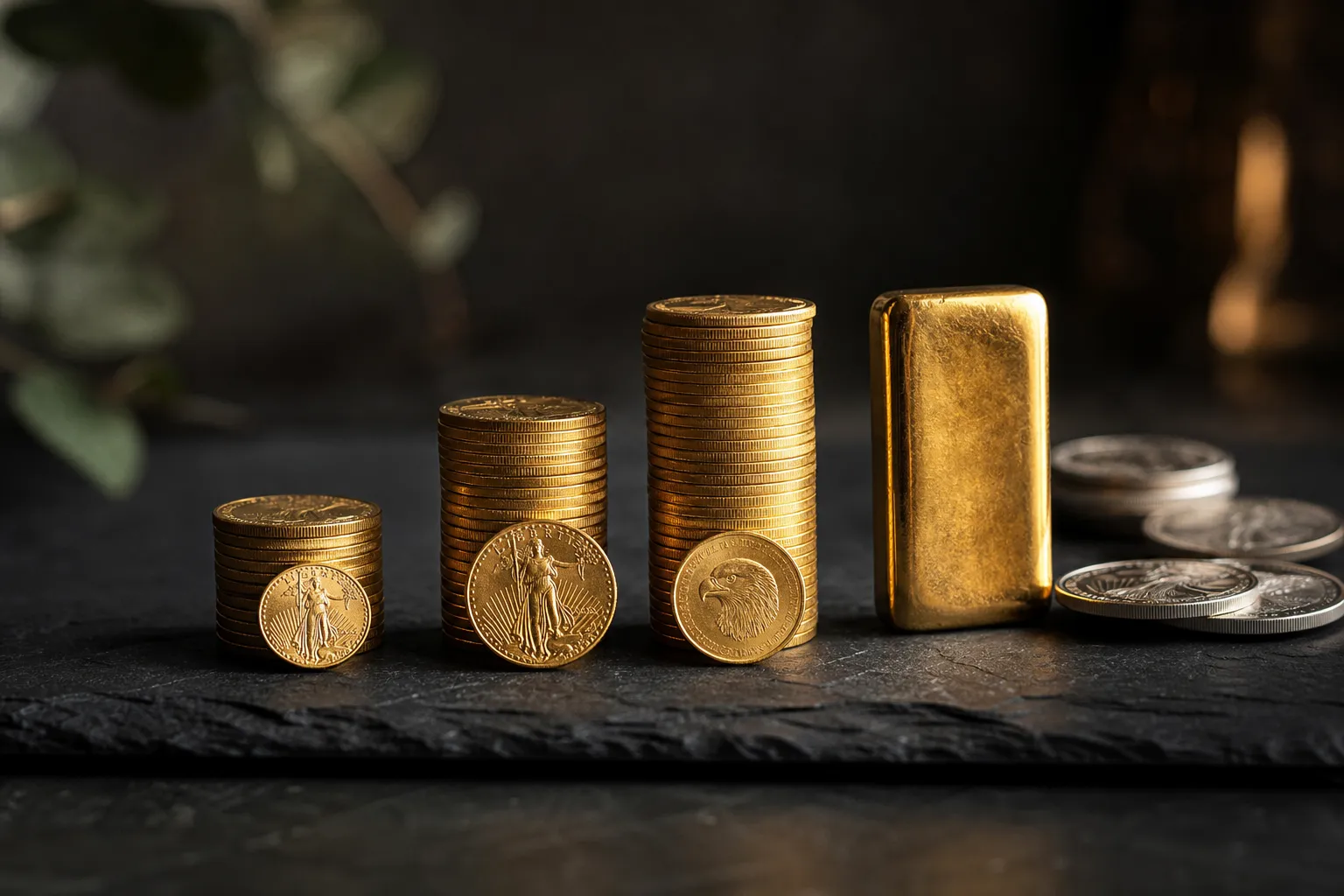
With gold near $4,100 an ounce (9 November 2026), $1,000 buys about two 1/10 oz coins, or one 1/4 oz coin if you can go to roughly $1,090. $5,000 covers a full 1 oz government coin plus some change, and $10,000 gets you about 2.25 oz. Under $5,000 the main cost is the premium. On average, 1/10 oz coins cost about 16% over spot and 1 oz coins about 3.5%, so put as much of your budget as you can into the largest size you can afford.
The baskets below use real prices from this week. Each item is explained in terms of liquidity, premium and divisibility, and the article ends with the mistakes that cost first-time buyers the most. This is general information, not financial advice.
What prices are these baskets based on?
On 9 November 2026 Kitco quoted spot gold at $4,098.30/oz and silver at $52.67/oz, which makes the gold-silver ratio about 78. Both metals are well below their peaks from earlier this year. Gold set its all-time high of $5,589.38 on 28 January 2026, so it is now about 27% lower. Silver reached $121.67 on 29 January and has since lost about 57%. Keep that in mind before you treat silver as the "safer" cheap option.
To keep the math simple, every basket uses $4,100 gold and $52.65 silver. Premiums are set at "good but realistic" levels from live dealer comparisons, not the single cheapest listing on the internet:
- 1 oz gold coin or bar: 2.5% over spot = $4,202.50
- 1/4 oz gold coin: 6% = $1,086.50
- 1/10 oz gold coin: 10% = $451.00
- 1 oz silver coin: 8% = $56.86
Prices will move. Check the live gold price before you buy and redo the math.
How much do premiums differ by size?
The cost of minting, packaging and shipping a coin is close to fixed, so the smaller the piece, the larger that cost is as a share of the gold inside. The table shows GoldSilver.ai's live dealer comparison for early November 2026. The last column shows how much of every $1,000 goes to premium rather than metal.
| Product | Avg. premium | Best deal seen | Premium per $1,000 spent (avg.) |
|---|---|---|---|
| 1 oz gold coin | 3.5% | 1.2% | ≈ $34 |
| 1 oz gold bar | 5.4% | 1.7% | ≈ $51 |
| 1/4 oz gold coin | 11.3% | 2.7% | ≈ $102 |
| 1/10 oz gold coin | 16.2% | 8.9% | ≈ $139 |
| 1 g gold bar (Valcambi) | 18.4% | 10.1% | ≈ $155 |
| 1 oz silver coin | 14.1% | 4.4% | ≈ $124 |
A few points about these numbers:
- Shopping around matters as much as product choice. On 1/4 oz coins, the gap between the average dealer (11.3%) and the best one (2.7%) is wider than the gap between most product types.
- 1 g bars are the most expensive way to own gold. GoldSilver.ai's history for the 1 g Valcambi bar shows a 32.8% average premium over about 215 days of data. They make sense as gifts, not as a way to build up ounces.
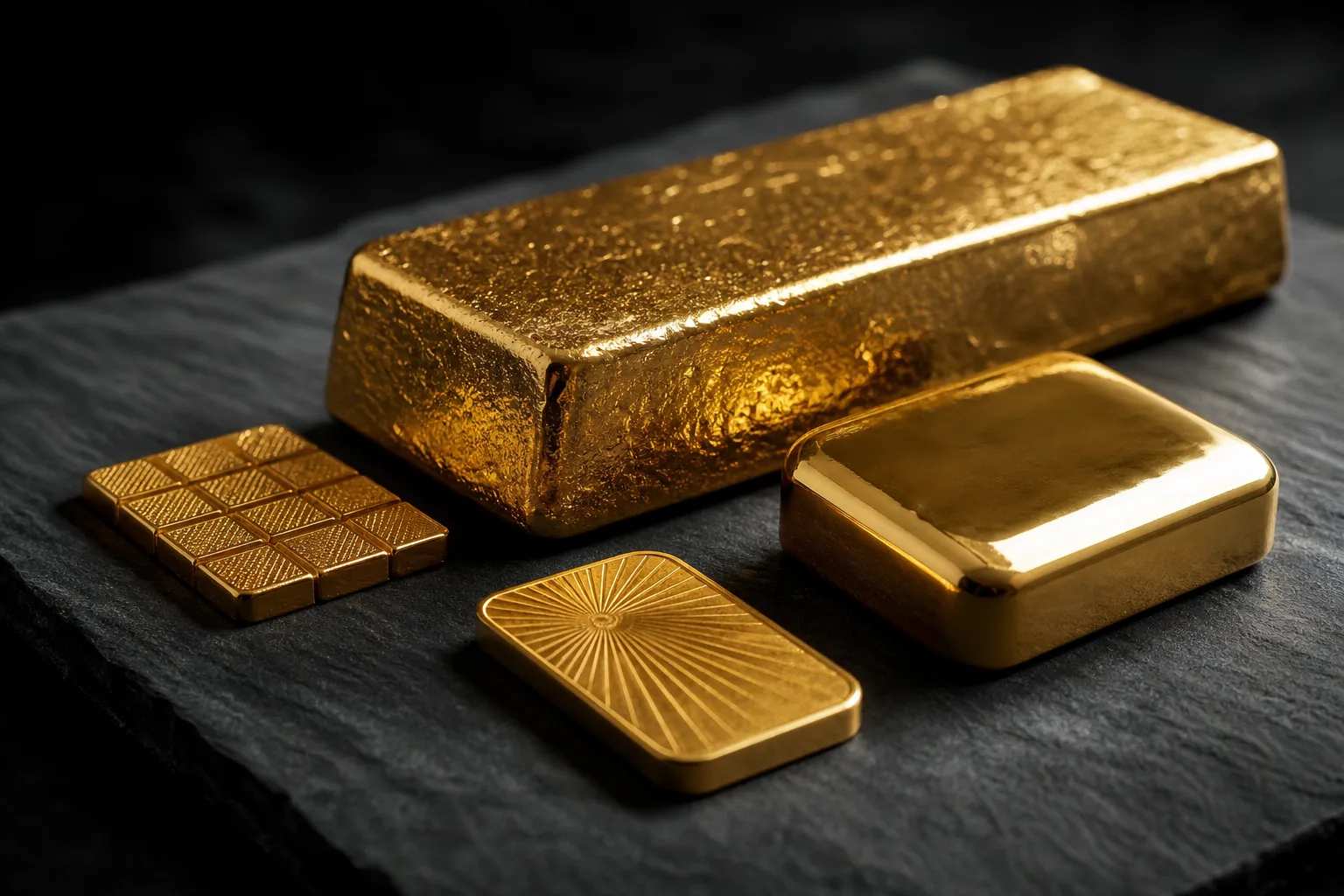
- Bars are not always cheaper than coins at 1 oz. This month the average 1 oz coin premium (3.5%) was below the average 1 oz bar premium (5.4%). The Krugerrand has the lowest premium among 1 oz coins most often. FindBullionPrices recorded a July 2026 average best-dealer premium of only 0.57% for it.
- Silver costs more to buy in percentage terms. A 1 oz silver coin costs nearly as much to make as a gold one but holds about 1/78 of the value. More of your money goes to the dealer, and the dealer buys it back at a wider discount too.
For more on why small sizes cost more, see our guide to whether fractional gold coins are worth it.
What gold should I buy with $1,000?
At $1,000 you can't get a full ounce. The real decision is how much premium you'll pay in exchange for being able to sell in small pieces. Here are three reasonable options:
| Basket | Contents | Cost | Metal you own |
|---|---|---|---|
| A. Gold only | 2 × 1/10 oz coins (e.g. Maple Leaf, Philharmonic) | $902.00 | 0.2 oz gold (6.2 g) |
| B. Gold + silver | 1 × 1/10 oz gold coin + 9 × 1 oz silver coins | $962.74 | 0.1 oz gold + 9 oz silver |
| C. Stretch | 1 × 1/4 oz gold coin | $1,086.50 | 0.25 oz gold (7.8 g) |
The case for C: If you can add about $90, a single 1/4 oz coin has the lowest premium per ounce of these three options. It is also big enough to be a real holding. On 9 November the best 1/4 oz Maple Leaf offer on GoldSilver.ai was 2.7% over spot, against 8.9% for the best 1/10 oz coin.
The case for A: Two pieces means you can sell half without selling everything. Expect to pay about 10–16% premium for that flexibility.
The case for B: Some silver gives you more physical pieces for the money and some exposure to its industrial demand. Silver has been far more volatile in 2026 than gold, though. The World Bank's October outlook forecasts silver averaging $62 in 2027, down from about $70 in 2026, and gold averaging $4,250, down from $4,600. Forecasts like these are often wrong in both directions, so treat them as context, not a reason to buy or wait.
What not to buy with $1,000: ten 1 g bars. At an 18% average premium, about $155 of the $1,000 never becomes gold.
What gold should I buy with $5,000?
At $5,000 you can buy a full 1 oz coin, the standard unit of the bullion market, and it should make up most of the basket.
| Basket | Contents | Cost | Metal you own |
|---|---|---|---|
| A. Core + change | 1 × 1 oz gold coin + 1 × 1/10 oz coin + 6 × 1 oz silver coins | $4,994.66 | 1.1 oz gold + 6 oz silver |
| B. All fractional | 4 × 1/4 oz coins + 1 × 1/10 oz coin | $4,797.00 | 1.1 oz gold |
Both baskets hold 1.1 oz of gold. In A the gold costs $4,653.50 and in B it costs $4,797.00. Being able to split your ounce into quarters costs about $145 extra, and you pay that again in a wider spread when you sell. Basket A is the better default. Basket B makes sense if you expect to sell in small amounts, for example to cover an expense without selling a whole ounce.
Which 1 oz coin? The most widely recognised options are the Krugerrand, Maple Leaf, American Eagle, Britannia and Philharmonic. All contain one troy ounce of gold, and any dealer anywhere will know them. When we checked, Maple Leaf (1.2%) and Krugerrand (1.9%) had the lowest premiums, with the Eagle and Philharmonic near 3%. A coin from a major mint is easier to resell than a bar from a little-known refiner. Our coins vs bars comparison covers the tradeoff in more detail.
What gold should I buy with $10,000?
At $10,000 you can hold two full ounces and still keep a smaller piece for flexibility.
| Basket | Contents | Cost | Metal you own |
|---|---|---|---|
| A. Gold + silver | 2 × 1 oz gold coins + 1 × 1/4 oz coin + 8 × 1 oz silver coins | $9,946.38 | 2.25 oz gold + 8 oz silver |
| B. All gold | 2 × 1 oz (coins or LBMA bars) + 1 × 1/4 oz coin + 1 × 1/10 oz coin | $9,942.50 | 2.35 oz gold |
Two suggestions for this budget:
- Buy two different products. For example, one Krugerrand and one Maple Leaf, or one coin and one 1 oz bar from a major LBMA refiner such as PAMP, Valcambi or Argor-Heraeus. If a buyer prefers one or pays more for it, you have a choice.
- Don't buy a single larger bar yet. 1 oz pieces already carry low premiums, so a single 2 oz or 50 g bar saves little. In exchange you lose the ability to sell half. Larger bars become worth considering at 100 g and up. FindBullionPrices tracked 100 g Valcambi bars at about 1.5% in mid-2026, but that size costs more than $13,000.
Browse the full range of gold coins if you want to compare mints side by side.
Why these items? Liquidity, premium and divisibility
Each item in the baskets above was chosen by checking three things:
- Liquidity: Can you sell it quickly anywhere for close to spot? Government bullion coins and LBMA bars from major refiners do best here. Obscure private rounds, "commemorative" medals and unbranded bars don't.
- Premium: How much over metal value do you pay, and how much of that do you get back? As Money Metals puts it, the true cost of ownership is the premium paid, minus the premium recovered on resale, plus any selling costs.
- Divisibility: Can you sell part of your holding? Smaller pieces give you that option, but each one costs more in premium. Balance the two. Don't push either one to the extreme.
What are the most common first-purchase mistakes?
- Buying proof, graded or "limited edition" coins as an investment. Their prices depend on what collectors will pay, not on gold content, and that premium often can't be recovered when you sell. A 2026 1/4 oz Eagle sold at a 13.3% premium this month when random-year Eagles were at 5.8%.
- Paying extra for a brand-new release. New-year and anniversary coins usually launch at higher premiums that fall over the following weeks. The 2027 issues now on pre-order, including the Britannia 40th-anniversary gold coin, the American Eagle and Buffalo, and the Perth Lunar Year of the Goat, may follow the same pattern. If you want metal rather than a particular design, buy random-year coins.
- Looking only at the price per coin. Compare total delivered cost, including shipping, insurance and any taxes or duties. Then compare the dealer's buyback price. The gap between the two is what you really pay.
- Splitting a small budget across too many products. Five different 1/10 oz coins cost more and are no easier to sell than two of the same coin.
- Buying from marketplaces or social media to save 2%. Fake coins and bars are common at the cheap end. Buy from an established dealer that guarantees authenticity.
- Trying to time the market. Gold fell from $5,589 to about $4,100 this year. Silver fell further. If you aren't sure about timing, splitting your purchase over a few months is a sensible way to avoid putting everything in at one price.
How should I store and insure a first purchase?
A $1,000–$10,000 holding is small enough to keep at home if you're careful:
- Keep coins in their original capsules or tubes, and keep bars sealed in their assay cards. Scratched coins and opened bars can sell for less.
- Use a bolted safe, not a drawer, and tell as few people as possible.
- Check your insurance. Home policies often limit cover for bullion and cash, so ask your insurer before assuming you're covered. Get a rider or a separate policy if you need one.
- Keep your invoices. You'll need them to prove what you paid, both for tax when you sell and for any insurance claim.
Once a holding grows past what you're comfortable keeping at home, a bank box or a professional vault becomes worth the fee. Our storage comparison covers the costs and tradeoffs.
Buying with crypto
If you hold Bitcoin, Monero or stablecoins, Bitgolder accepts 35 cryptocurrencies and locks your USD total at checkout. Shipments are insured, discreet and require a signature, and they go to 77 countries with customs duties and import taxes included in the price. The $499 minimum order is low enough for every basket above. When you want to sell, Bitgolder also buys back at live spot through /sell. See buying gold with Bitcoin for how payment works.
The short version
- $1,000: One 1/4 oz government coin if you can reach about $1,090. Otherwise, two 1/10 oz coins.
- $5,000: One 1 oz Krugerrand or Maple Leaf, with the rest in a 1/10 oz coin or a few silver coins.
- $10,000: Two 1 oz pieces from different mints or refiners, plus one fractional coin.
- Always: Choose recognised bullion over collectibles, compare dealers on total delivered cost, and check the buyback price before you buy.
This is general information, not financial advice. Prices and premiums change daily. Check live quotes before buying.
Sources
- Kitco: Live Gold Price, 9 Nov 2026 (spot $4,098.30; all-time high $5,589.38 on 28 Jan 2026)
- Kitco: Live Silver Price, 9 Nov 2026 (spot $52.67; all-time high $121.67 on 29 Jan 2026; ratio 78.2)
- Kitco News: World Bank sees gold holding above $4,000 through 2028 (5 Nov 2026)
- GoldSilver.ai: 1 oz gold coin prices and premiums
- GoldSilver.ai: 1 oz gold bar prices and premiums
- GoldSilver.ai: 1/4 oz gold coin prices and premiums
- GoldSilver.ai: 1/10 oz gold coin prices and premiums
- GoldSilver.ai: 1 gram Valcambi gold bar premiums
- GoldSilver.ai: 1 oz silver coin prices and premiums
- FindBullionPrices: 1 oz Krugerrand premium history (2025–2026)
- FindBullionPrices: 1/4 oz Gold Maple Leaf premium history
- FindBullionPrices: 2026 1/10 oz Gold Britannia premium history
- FindBullionPrices: Valcambi 100 g gold bar premium history
- FindBullionPrices: 2026 Silver Maple Leaf premium history
- Money Metals: Gold Premium: what it is and how it affects buyers and sellers
Frequently asked questions
What is the best gold to buy with $1,000?
With gold near $4,100 an ounce in November 2026, $1,000 does not buy a full ounce. The most cost-efficient option is one 1/4 oz government bullion coin, such as a Maple Leaf or Krugerrand, at about $1,050 to $1,140. If you must stay under $1,000, two 1/10 oz coins cost about $900 but carry higher premiums, averaging around 16% over spot.
How much gold can $5,000 buy in 2026?
At spot of about $4,100 per ounce, $5,000 buys one 1 oz bullion coin (about $4,150 to $4,250 including a typical 1 to 3.5% premium). The rest can buy a 1/10 oz coin or a few 1 oz silver coins. That adds up to about 1.1 troy ounces of gold. Splitting the same gold into 1/4 oz coins instead costs roughly $145 more in premiums.
Should a beginner buy gold coins or gold bars?
At 1 oz, both are good choices from recognised issuers. In early November 2026, 1 oz gold coins averaged about 3.5% over spot and 1 oz bars about 5.4%, so coins were not more expensive. Government coins like the Krugerrand, Maple Leaf, Eagle and Britannia are recognised by any dealer worldwide. Bars become cheaper per ounce mainly at 100 g and above.
Why do small gold coins and 1 gram bars cost more per ounce?
Minting, packaging and distribution cost almost the same whatever the size, so smaller pieces carry a larger percentage premium. In November 2026, dealer averages were about 3.5% for 1 oz coins, 11% for 1/4 oz, 16% for 1/10 oz and over 18% for 1 g bars. For a 1 g bar, about $155 of every $1,000 spent goes to premium rather than gold.
Is silver a better first purchase than gold on a small budget?
Silver gets you more physical pieces for the money, but it carries higher percentage premiums and has been much more volatile. Silver reached $121.67 in January 2026 and was about $52.67 on 9 November, a fall of roughly 57%. Gold fell about 27% from its peak over the same period. Many beginners keep silver as a smaller share of a gold-led basket.
Should I buy 2027 or newly released gold coins as a first purchase?
For a beginner focused on metal value, random-year bullion coins are usually cheaper. New-year and anniversary releases often launch at higher premiums, which then fall over the following weeks. In November 2026, for example, a dated 1/4 oz Gold Eagle sold at about 13% over spot while random-year 1/4 oz Eagles were near 6%. Buy a new design only if you specifically want it.
How should I store a $1,000 to $10,000 gold purchase?
Keep coins in their original capsules and bars in sealed assay cards, store them in a bolted home safe, and tell few people. Many home insurance policies limit cover for bullion, so ask your insurer about a rider. Keep purchase invoices for tax and insurance purposes. Bank boxes or professional vaults become worthwhile as the holding grows.
Ready to buy gold with crypto?
Browse 400+ LBMA-certified coins and bars, priced live and shipped fully insured.
Shop the vault