Silver Britannia vs Eagle vs Maple 2026: Premiums, Tax & Milk Spots
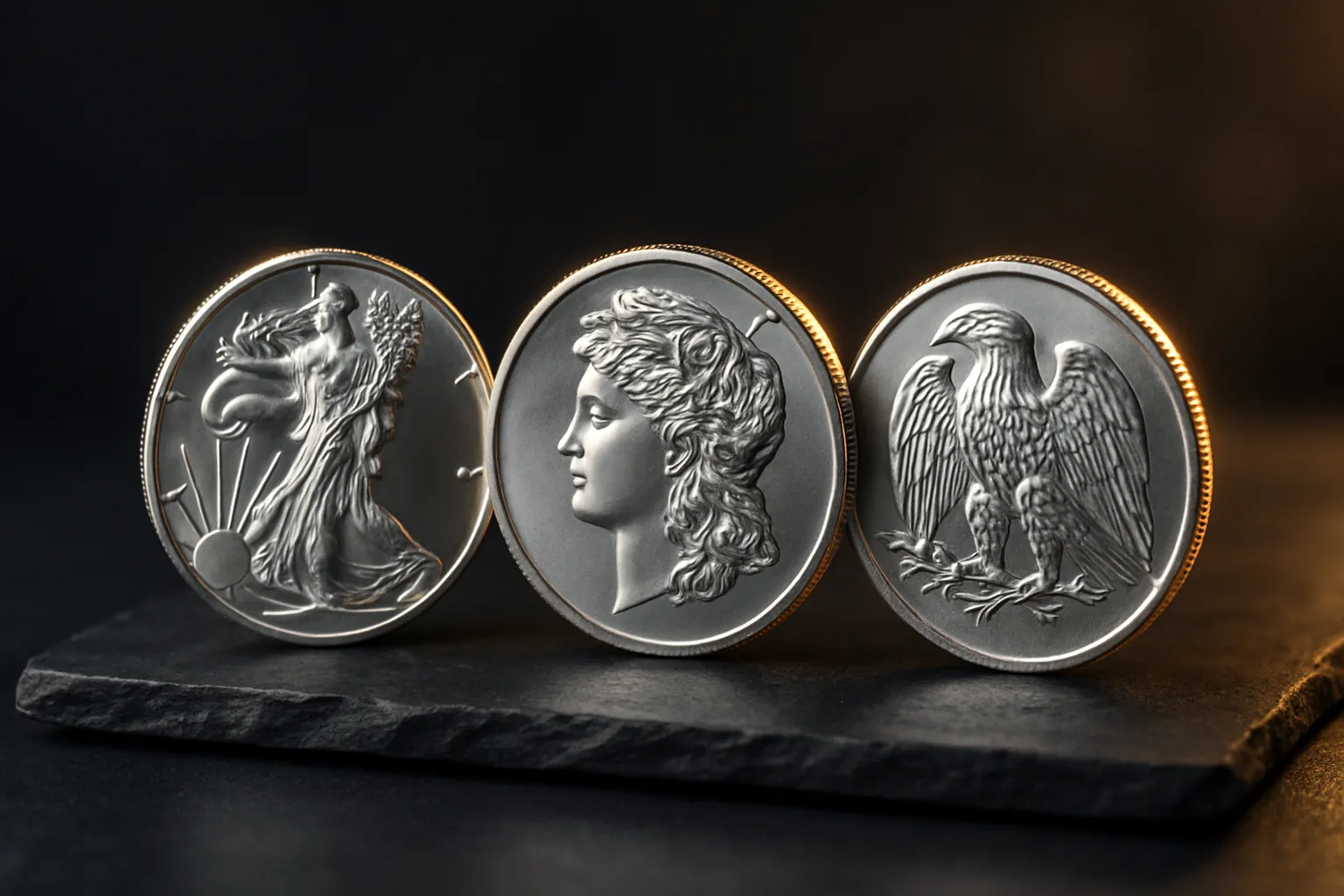
Three one-ounce silver coins, three government mints, near-identical metal. And yet for a UK buyer the wrong choice can cost you 20% of your gains, while for a US buyer the wrong choice costs 10% on the way in. Silver is where tax and premium matter far more than the coin itself. Here's the honest head-to-head.
The specs
| Silver Britannia | American Silver Eagle | Canadian Silver Maple | |
|---|---|---|---|
| Mint | The Royal Mint | United States Mint | Royal Canadian Mint |
| Purity | .999 | .999 | .9999 |
| Face value | £2 | $1 | CAD $5 |
| Diameter | 38.61 mm | 40.60 mm | 38.00 mm |
| Thickness | 3.00 mm | 2.98 mm | 3.29 mm |
| First issued | 1997 | 1986 | 1988 |
All three contain one troy ounce of silver. The Maple's extra nine works out to about 0.03 g more silver per coin — a marketing differentiator, not an investment one, as we cover in purity explained.
One thing to watch when buying secondhand: Silver Britannias were .958 fine through 2012 and only became .999 from 2013.
Premiums: the Eagle problem
With silver around $63.78 in June 2026, the Eagle carried roughly a 20% premium (about $76.54 a coin) against the Maple's ~15% (about $73.35). Typical 2026 ranges:
- American Eagle: ~18–30%
- Silver Britannia: ~11–18%
- Canadian Maple: ~11–17%
The Eagle's premium is structural, not a blip. The US Mint's statutory pricing to Authorized Purchasers builds in a fixed mark-up, production costs are high, supply has been repeatedly constrained and domestic demand is enormous. You're paying for US-market liquidity — which is worth a great deal inside the US and essentially nothing outside it.
Anti-counterfeit features
Maple Leaf has the strongest layered package: precision radial lines that diffract light, plus Bullion DNA since 2015 — a laser micro-engraved maple leaf privy mark containing the year, visible only under magnification and recorded at the mint for later verification.
Britannia carries the Royal Mint's 2021 security suite: a latent image flipping between padlock and trident, surface animation of moving waves, micro-text reading DECUS ET TUTAMEN, and tincture lines on the shield. Crucially, all four are checked by simply tilting the coin — no equipment.
Eagle historically had the weakest overt security. The 2021 Type 2 redesign added an edge notch — a deliberate gap in the reeding — and the Mint has quietly moved its position in 2022 and again in 2023 as a covert measure. It's a feature, not a defect.
For verification without tools, the ranking is Britannia, then Maple, then Eagle. All three should still pass the ping, magnet-slide and dimension checks in our authentication guide.
Milk spots
Cloudy white blotches that surface on .999+ silver, sometimes years after minting. They're purely cosmetic — the silver content is untouched — but they hurt resale on graded and collector-grade coins.
The cause is a manufacturing one: residue from blank cleaning and annealing that wasn't fully rinsed before striking, reacting with the surface over time. That's why spots appear on sealed coins nobody has handled.
The Maple was notorious for it. The RCM responded with MINTSHIELD, applied to every Silver Maple dated 2018 and later, and reports since have improved markedly — though it isn't eliminated. Britannias and Eagles are affected less often but aren't immune.
If you're buying purely for silver content, ignore this entirely. If you might sell into a collector market, buy sealed tubes, store dry, avoid PVC flips and prefer 2018+ Maples.
Tax: the part that actually decides it
Silver's fundamental disadvantage: investment gold is VAT-exempt across the UK and EU, silver is not. It's treated as an industrial commodity, so VAT is mandatory — 20% in the UK, 19% in Germany.
Do the arithmetic honestly. A 20% VAT charge on top of a 12–20% premium puts you roughly 32–40% above spot on day one, and you'll sell at or near spot. Silver has to rise about 35–50% before you break even. That's the single most important fact in this article, and most silver guides skip it.
Then CGT splits the three apart
- Silver Britannia — CGT-exempt. UK legal tender, so gains are outside Capital Gains Tax entirely, with no limit.
- American Eagle — not exempt. Foreign currency; gains above the £3,000 annual allowance are taxable.
- Canadian Maple — not exempt. Same treatment.
How that resolves in practice
The two taxes interact in a way that flips the answer depending on your size:
- Small holding, never likely to exceed the £3,000 annual CGT allowance: the Britannia's exemption is worth nothing to you. Buy whichever coin is cheapest per ounce — usually the Maple.
- Large or long-held UK position: the exemption can be worth 18–24% of your entire gain, which dwarfs a 1–3% premium difference. Buy Britannias.
- UK buyers and Eagles: hard to justify. You pay the highest premium and get no CGT relief.
One further option: silver held in a bonded warehouse or free-trade zone (Zurich, Channel Islands) can be bought without VAT while it stays there — VAT falls due on import. That removes the 20% drag but adds storage cost and counterparty risk, and doesn't confer CGT exemption on non-Britannia coins. See our storage guide.
US buyers: no VAT, sales tax varies by state (many exempt bullion), and federal CGT treats physical silver as a collectible at up to 28%. There's no US equivalent of the Britannia exemption.
Liquidity by region
USA: the Eagle dominates — deepest bid, tightest spreads. UK: the Britannia is the default unit of account, and dealers bid strongly. Europe: Maple and Britannia both highly liquid; Eagles command a premium but are the priciest entry. The Eagle's US premium does not travel — buy them in Britain and you've imported a premium you can't recover on sale.
The verdict
UK resident, meaningful holding: Silver Britannia. Competitive premium and the only CGT exemption of the three.
UK resident, small stack: Maple, on lowest premium.
US buyer: Eagle for liquidity, Maple for cost.
Pure ounces per pound spent: Maple — or bars and rounds, which are cheaper still but never CGT-exempt.
And if the 20% VAT is the thing stopping you, that's a legitimate reason to weight toward gold instead — it carries no VAT at all. Our gold-to-silver ratio guide is the sensible way to think about the split.
Bitgolder stocks all three coins — browse silver, payable in Bitcoin, Monero, stablecoins and 30+ coins at a transparent premium over live spot, shipped insured and unmarked. See how it works.
General information, not tax advice. Rates and allowances change — confirm your position before buying at size.
Frequently asked questions
Which silver coin is best to buy?
It depends where you pay tax. For a UK resident with a meaningful holding, the Silver Britannia — it is the only one of the three exempt from Capital Gains Tax, at a competitive premium. For a US buyer, the Eagle for liquidity or the Maple for cost. For pure ounces per pound, usually the Maple.
Why are Silver Eagles so expensive?
It is structural. The US Mint's statutory pricing to Authorized Purchasers builds in a fixed mark-up, production costs are high, supply has been repeatedly constrained and US retail demand is enormous. Premiums run around 18–30% versus 11–17% for a Maple.
Do silver Britannias have VAT?
Yes, 20% in the UK. Only investment gold is VAT-exempt; silver is treated as an industrial commodity so VAT is mandatory across the UK and EU. The alternatives are buying into a bonded warehouse offshore, or differential taxation on qualifying coins in Germany and Austria.
Are silver Maples CGT free in the UK?
No. Only UK legal tender coins qualify for the exemption. Canadian Maples, American Eagles, Krugerrands and Philharmonics are all foreign currency and liable to UK Capital Gains Tax on gains above the £3,000 annual allowance.
Which silver coin has the lowest premium?
Of the three, the Canadian Maple — typically a few dollars per coin below the Eagle, with the Britannia close behind. Generic rounds and 100 oz or 1 kg bars are cheaper still, but they are not legal tender and so never CGT-exempt in the UK.
What causes milk spots on silver coins?
Residue from the blank cleaning and annealing process that was not fully rinsed before striking, reacting with the surface over time. It is a manufacturing issue, which is why spots appear on sealed, never-handled coins. Purely cosmetic, but it hurts collector resale.
Ready to buy gold with crypto?
Browse 400+ LBMA-certified coins and bars, priced live and shipped fully insured.
Shop the vault