How to Tell if Gold Is Real: Eight Tests in the Order You Should Actually Use Them
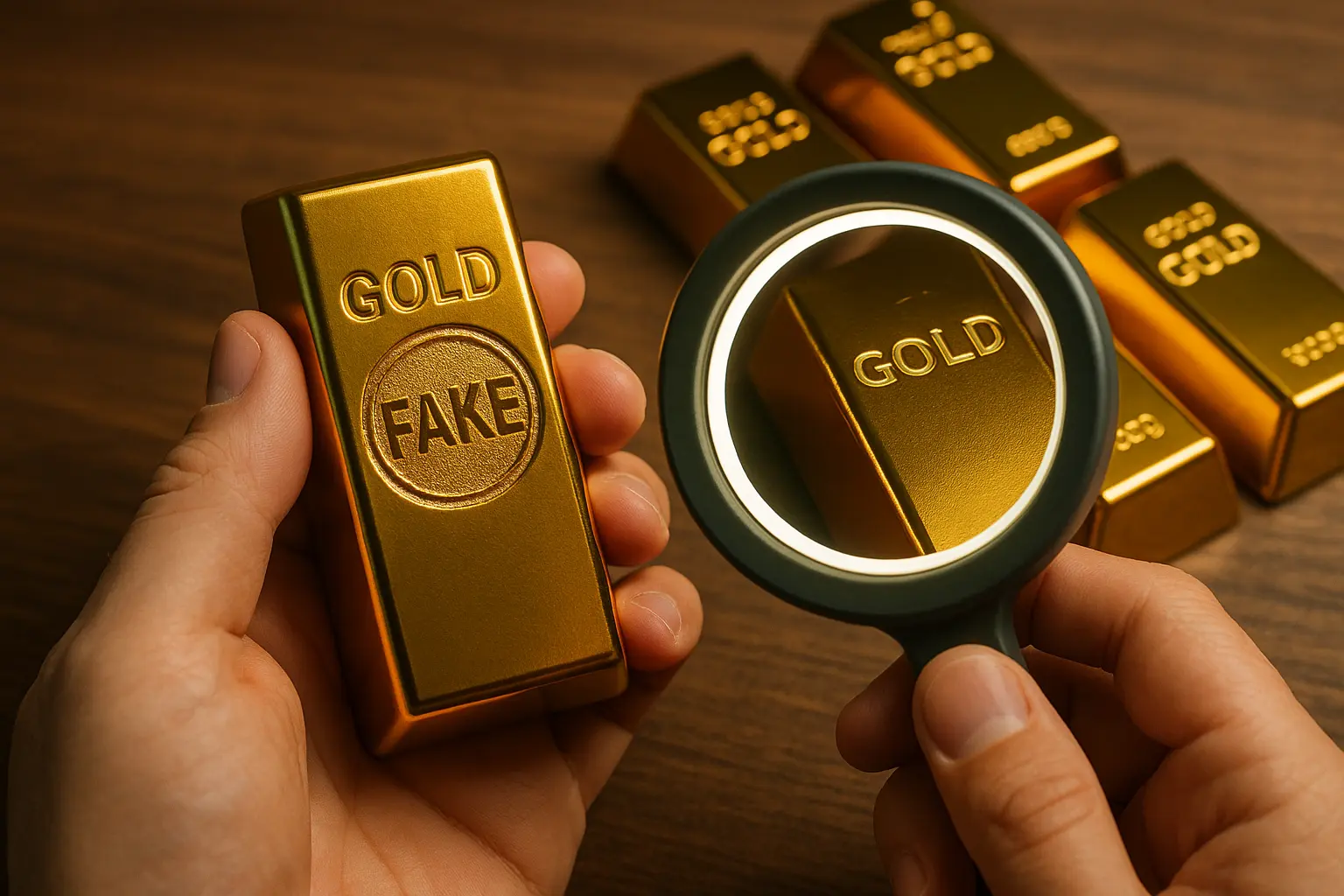
The old title promised methods that “never fail.” That is not how testing works. Every home test can be beaten by a good enough counterfeit; what the tests do is catch the cheap fakes, which are most of them, and tell you when to escalate to a test that cannot be beaten. Here they are in the order you should actually use them — cheapest first, decisive last — with what each one catches and what it misses.
Start with what counterfeiters cannot easily fake
Gold has a density of 19.32 g/cm³. Almost nothing else that colour comes close, and the one metal that does — tungsten, at 19.25 — is the reason the last two tests on this list exist.
1. Weight and dimensions — two minutes, catches most fakes
Every bullion coin and bar has a published weight, diameter and thickness. A gold-plated brass or lead fake of the right diameter will be the wrong weight; one of the right weight will be the wrong size, because nothing but gold and tungsten is dense enough to fit.
- Weigh on a scale reading to 0.01 g. A 1 oz coin should be within a few hundredths of a gram of spec.
- Measure diameter and thickness with digital callipers against the mint's figures.
- Any deviation beyond the mint's tolerance is a stop sign.
Catches: plated base-metal fakes. Misses: tungsten cores, which match both weight and size.
2. Magnet — thirty seconds
Gold is not magnetic. A strong neodymium magnet should have no pull on a genuine coin or bar. It is a crude test — many base metals are also non-magnetic — so a pass proves nothing, but a fail is conclusive.
Catches: ferrous fakes. Misses: everything else.
3. Ping test — the acoustic signature
Balance a coin on a fingertip and tap it with another coin. Gold rings with a long, clear, high tone; base metals give a dull, short thud. Smartphone apps compare the frequency against a database for the specific coin. It is surprisingly discriminating and works less well on bars, which do not ring the same way.
Catches: most plated fakes, some tungsten. Misses: well-made tungsten coins can come close.
4. Specific gravity — the density test, done properly
This is the weight test made rigorous. Weigh the item dry; weigh it suspended in water; divide dry weight by the difference. Gold gives 19.3. A 22k coin (Eagle, Krugerrand) gives about 17.5 because of the alloy — use the mint's figure, not pure gold's.
Catches: every base-metal fake. Misses: tungsten, which sits at 19.25.
5. Security features — coin-specific and free
Modern bullion coins carry anti-counterfeit features that are genuinely hard to replicate:
- Britannia: latent image that changes between a padlock and a trident as you tilt it, micro-text, tincture lines, surface animation.
- Maple Leaf: radial lines and a micro-engraved laser mark with the year, visible under magnification.
- Philharmonic, Eagle: fine relief detail that cheap dies smear.
Compare against the mint's own images under a loupe. Soft detail, a wrong font, a missing micro-mark or a privy in the wrong place are all disqualifying.
6. Minted-bar assay cards and Veriscan-type systems
PAMP and several other refiners issue minted bars in sealed cards with a serial number on both card and bar, and PAMP's Veriscan app photographs the bar's surface microstructure and compares it to the refiner's record. A card that has been opened and resealed, a serial mismatch, or a Veriscan fail is decisive. This is why you should never open an assay card.
7. XRF — the test that ends the argument
An X-ray fluorescence analyser reads the elemental composition of the surface in seconds, non-destructively. Every serious dealer has one. It confirms purity to a decimal place and identifies the alloy.
Catches: any surface fake. Misses: a thick gold shell over a tungsten core — XRF only reads the outer fraction of a millimetre.
8. Ultrasound — the one tungsten cannot pass
An ultrasonic thickness gauge measures how fast sound travels through the item. Gold's velocity is about 3,240 m/s; tungsten's is about 5,180. A gold-shelled tungsten bar reads wrong no matter how good the shell is. Dealers buying larger bars use this routinely, and it is the reason the tungsten-core fake — the only one that beats density — is not a practical threat to anyone who has the bar checked.
What not to do
- Acid tests. They scratch the item, they only test the surface, and a plated fake passes. Fine for scrap jewellery, wrong for bullion.
- Bite tests. Lead is also soft.
- Trusting a certificate alone. Certificates are the easiest part of a coin to counterfeit.
- Buying from a marketplace to save a few percent. The premium at a dealer is partly the cost of the XRF and the ultrasound gauge you did not have to buy.
The practical order
- Weight, dimensions, magnet — at home, on delivery.
- Ping and security features — at home, five minutes.
- Specific gravity if anything is borderline.
- XRF and ultrasound at a dealer for any bar over 100 g, any secondary-market purchase, or anything that failed a step above.
For the patterns that surround fakes — below-spot pricing, unaccredited refiners, marketplace listings — see gold scams and counterfeits in 2026. For what to do if a parcel arrives looking wrong, photograph it before opening.
Why buying from a dealer changes the question
Every coin and bar we sell comes from an LBMA Good Delivery refiner or a sovereign mint, through supply chains that do not involve a marketplace. We test what we buy in. That is most of what the premium pays for. Prices are struck from live spot — $4,329.90 per ounce as this was written — and everything ships insured and signature-required.
General information. No home test is conclusive on its own; for anything valuable, have it checked professionally.
Ready to buy gold with crypto?
Browse 400+ LBMA-certified coins and bars, priced live and shipped fully insured.
Shop the vault