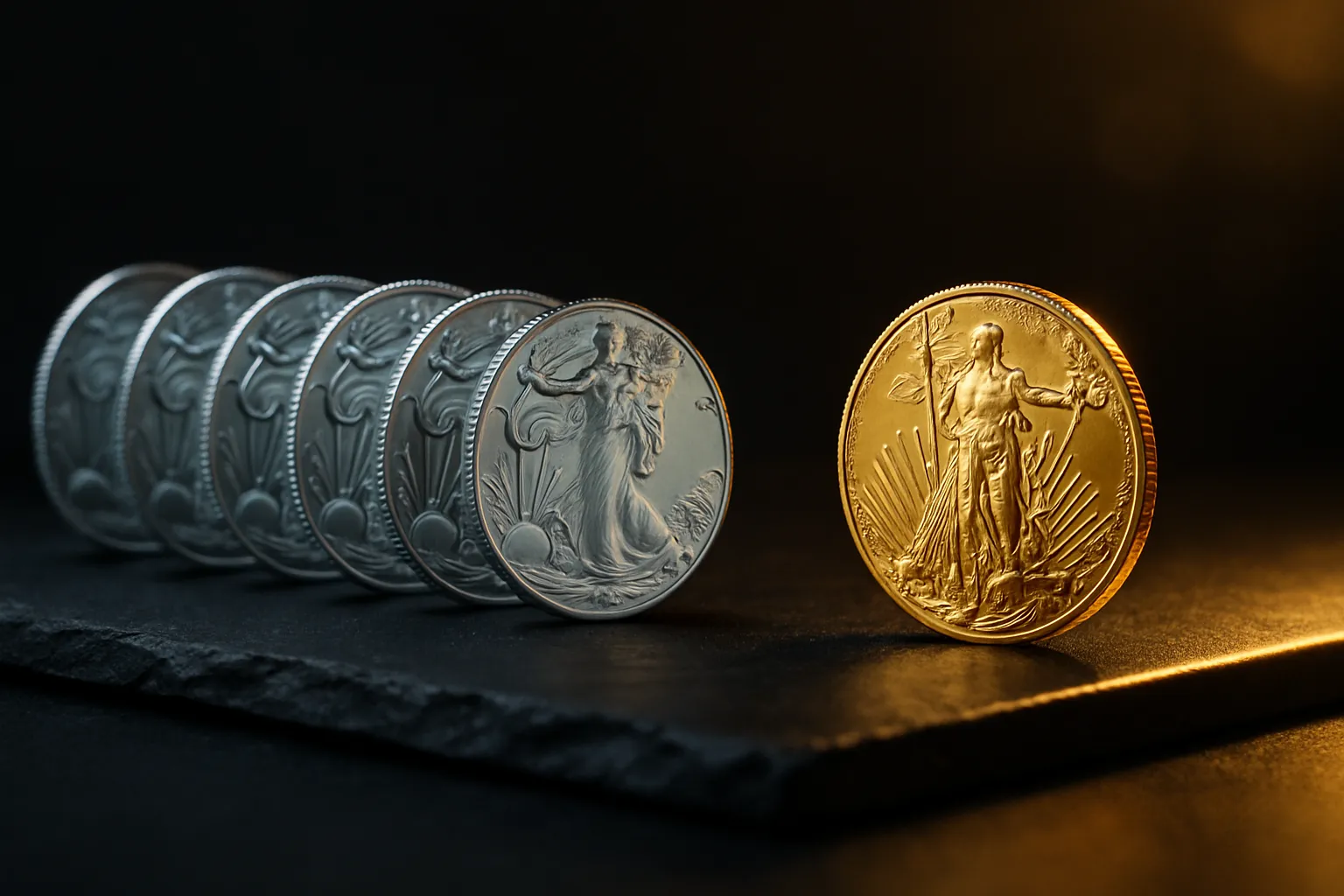
From Bitcoin to Bullion: Why Crypto Investors Are Buying Gold in 2026 — and the Case Against

For most of Bitcoin's life, “digital gold” was an argument for owning Bitcoin instead of gold. In 2026 a growing number of crypto holders own both, and a measurable share of them are moving profits from one into the other. This is why — with the data, and with the reasons it might not apply to you.
What actually changed
Gold has been the better-performing “safe haven” through 2025–26, and Bitcoin has started moving with it rather than against it. Three facts from the last twelve months:
- Gold set a succession of record highs and, at the time of writing, sits at $4,349.70 on our live feed. Bitcoin is at $77,300 — well below its own high.
- Bitcoin's 90-day correlation with gold reached its highest level in roughly six years in September 2026. The two assets are trading the same macro tape.
- Retail investors rotated visibly from Bitcoin into gold in the fourth quarter of 2025, at the same time that global gold ETFs recorded their second-strongest year on record — 801 tonnes of inflows — followed by a record $19 billion in January 2026 alone.
The narrative that the two were opposites has not survived contact with the data. What has emerged instead is a portfolio question: how much of each, and when to move between them.
Why crypto holders buy gold — the five real reasons
1. Taking profit into something that does not correlate with the exit
Selling Bitcoin into dollars means holding the currency whose debasement was the reason for buying Bitcoin in the first place. Selling into gold takes profit out of a volatile asset into a scarce one without touching fiat. Whether that is smart depends entirely on your view of the dollar — but it is coherent, and it is the most common reason given.
2. Volatility without abandoning hard assets
Bitcoin's drawdowns are routinely 50–80%. Gold's are historically 20–45%, and its rallies are slower. A holder who wants to stay out of fiat but cannot stomach another 70% drop has one obvious place to go.
3. Counterparty risk — the version crypto people already understand
“Not your keys, not your coins” is the founding lesson of self-custody. Physical gold is the same lesson, older: no exchange, no custodian, no smart contract, no chain. Once it is delivered, nobody else has to stay solvent for you to keep owning it. Crypto holders are unusually receptive to that argument because they have watched exchanges fail.
4. Central banks are on the same side
Official-sector gold buying exceeded 1,000 tonnes in each of the last three years; a record 45% of central banks say they intend to add more. Nobody's central bank is accumulating Bitcoin at that scale. For a holder who thinks in terms of “what are the biggest balance sheets doing,” that asymmetry is hard to ignore.
5. The mechanics finally work
Five years ago converting crypto to metal meant an exchange, a bank wire, and a dealer who did not want to talk to you. Now a dealer can price gold against live spot, take Bitcoin, Ethereum, Monero or a stablecoin directly on-chain, lock the USD total while you pay, and ship insured. The friction that kept the two worlds apart has mostly gone. Here is how ours works.
The honest counter-arguments
An article by a gold dealer arguing for gold is not evidence of anything. So:
- Bitcoin's upside is larger. If the thesis that made you buy Bitcoin is still intact, selling the asset with the higher expected return to buy the one with the lower is a bet on volatility, not on value.
- Gold has already run. It has more than doubled in two years. The banks' 2026 targets were mostly cut mid-year. Buying the top of one asset with the profits of another is a familiar way to lose twice.
- Gold is not portable, divisible or programmable in the way Bitcoin is. Moving $100,000 of gold across a border is a customs event. Moving $100,000 of Bitcoin is a transaction.
- Correlation cuts both ways. If the two now trade together, gold does not diversify a Bitcoin position as much as it did. The six-year correlation high is an argument for holding both less confidently, not more.
The strongest version of the case is not “gold beats Bitcoin.” It is: most people who hold one have never held the other, and the relationship between them has changed enough that the question deserves a fresh look.
What a rotation actually looks like
The exchange rate that matters is not gold in dollars or Bitcoin in dollars. It is ounces per Bitcoin: at today's prices, one BTC buys about 17.8 oz of gold. That number, not either dollar price, is what a holder rotating between the two is actually trading.
Common patterns among people who hold both:
- Profit-taking in ounces. When Bitcoin runs, convert a fixed fraction of the gain into metal. Removes the need to guess the top.
- Rebalancing on the ratio. When one BTC buys unusually many ounces, buy gold; when it buys unusually few, hold. Same logic as the gold-silver ratio.
- Core and satellite. Physical metal as the part that is never sold; Bitcoin as the part that is traded. Different jobs, different assets.
None of these require a view on which asset is “better.” They require deciding what each one is for.
Practical notes for buyers
- Price locks matter. Both assets move. A dealer that quotes live spot and locks the USD total while you pay removes the risk of the gold price moving during a confirmation window. Ours does.
- Tax. Converting Bitcoin to gold is a disposal of Bitcoin for tax purposes in most jurisdictions, and the gold has its own basis from that day. See what happens for tax when you buy gold with Bitcoin.
- Format. Bars for the core, lowest premium; 1 oz coins for the portion you may sell in pieces.
- Privacy coins. If the reason you hold Monero is privacy, that reason survives the conversion — see buying gold with Monero.
- Delivery and storage. Metal has a physical failure mode Bitcoin does not. Read who pays if a delivery goes wrong and what storage actually costs before the parcel arrives.
The short version
Gold outperformed Bitcoin as a safe haven through 2025–26, Bitcoin now trades with gold rather than against it, and both retail and institutional flows have shifted toward metal. Crypto holders buy gold to take profit out of fiat, to reduce volatility without leaving hard assets, and because self-custody is a lesson they already learned. The counter-arguments — Bitcoin's larger upside, gold's recent run, rising correlation — are real, and any honest version of this decision weighs them.
You do not have to pick a side. You have to decide what each asset is for.
General information, not investment advice. Both assets are volatile and prices above will date.
Ready to buy gold with crypto?
Browse 400+ LBMA-certified coins and bars, priced live and shipped fully insured.
Shop the vault