Platinum Price — Complete 2026 Market Guide & Analysis
Platinum has spent most of the past decade trading at a discount to gold — a historical inversion of the long-term pattern. In 2026, that discount is structurally narrowing as supply deficits and a surge in retail bar-and-coin buying meet weak ETF flows and softening automotive demand. The result is a market where the supply/demand fundamentals matter more than the macro narrative.
In short: The platinum market in 2026 is heading for its fourth consecutive annual deficit, with supply at 7,377 koz versus demand at 7,674 koz — a shortfall of approximately 297 koz, per the World Platinum Investment Council (WPIC). Above-ground stocks fall to 1,747 koz by year-end, less than three months of global demand cover. Bar-and-coin investment is up 35% year-on-year to 725,000 oz — the highest level in the WPIC's recorded history.
2026 platinum supply outlook (WPIC)
Total platinum supply for 2026 is projected at 7,377 koz, up 2% year-on-year. The increase is entirely on the recycling side.
- Mine supply: 5,551 koz — broadly flat year-on-year. Modest gains in South African production are offset by declines elsewhere. South Africa remains the dominant source at roughly 70% of global mined platinum.
- Recycling: 1,826 koz — up 9% year-on-year. The surge is driven by recovery of platinum from end-of-life autocatalysts, particularly older diesel vehicles being scrapped in Europe.
The mine-supply stagnation is the structural story. Platinum mining is concentrated, capital-intensive, and operating at low or negative margins for several producers at current price levels. There is no realistic supply response on a 2–3 year horizon that would close the deficit.
2026 platinum demand outlook
Total platinum demand for 2026 is forecast at 7,674 koz, down 9% year-on-year. The decline is driven entirely by investment-flow categories; consumption fundamentals remain firm.
- Automotive demand: 2,959 koz — down 2% year-on-year. The slowing reflects continued EV penetration in light vehicles, partly offset by platinum substitution for palladium in autocatalysts and growing hydrogen fuel-cell adoption.
- Industrial demand: Steady, supported by chemicals, glass, electronics and hydrogen-economy applications.
- Jewellery demand: Modest growth in China and India offset by mature-market softness.
- ETF flows: Net outflow of ~100 koz forecast — investors moving capital toward gold ETFs.
- Exchange stocks: Net outflow of ~100 koz, indicating physical drawdown rather than accumulation in NYMEX/TOCOM warehouses.
- Bar and coin investment: 725 koz — up 35% year-on-year. Retail bullion buyers are treating platinum as a cheaper alternative to gold.
Above-ground stocks — the squeeze metric to watch
Above-ground platinum stocks are projected to fall to 1,747 koz by year-end 2026. At the forecast 2026 demand rate, that's less than three months of global cover. Historically, platinum has been able to weather supply deficits because ETF holdings, exchange warehouses, and dealer inventories provided a buffer. In 2026, that buffer is depleting.
This is the metric to monitor. If above-ground stocks fall below 1,500 koz in 2027, the market faces genuine availability stress — the conditions that historically precede sharp price moves. Conversely, if ETF outflows reverse (gold-to-platinum rotation by retail investors), the buffer could rebuild rapidly.
The gold-platinum ratio
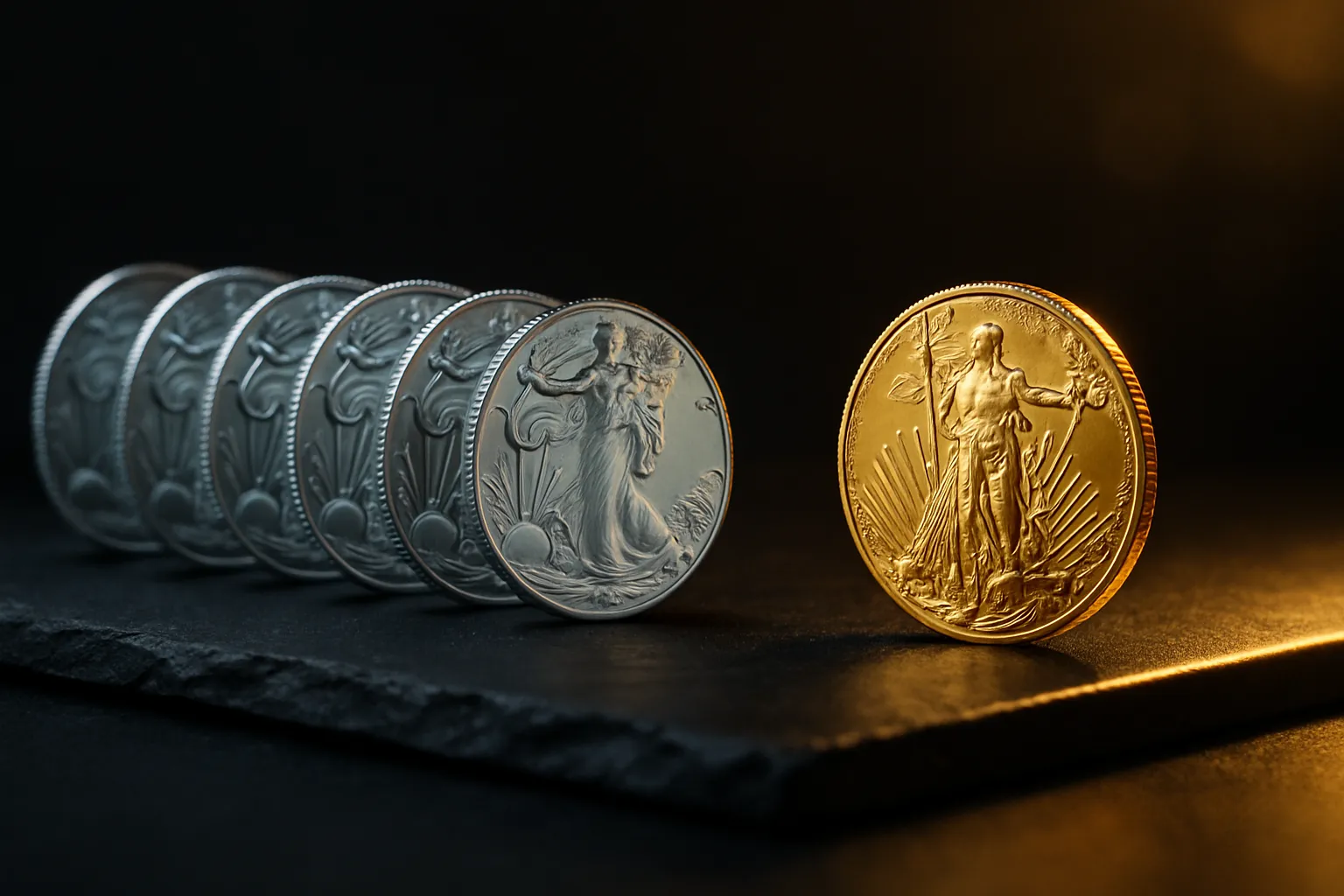
Historically, platinum has traded at a premium to gold for most of the post-1970s era — at one point reaching a 2.4:1 platinum-to-gold ratio during the early 2000s commodity supercycle. That relationship inverted in 2015 and has remained inverted ever since. In 2026, with gold approaching USD 4,500–5,000/oz and platinum around USD 1,100–1,250/oz, the ratio is approximately 4:1 in gold's favor.
The contrarian case for platinum rests on mean reversion. If you believe the long-term ratio re-normalizes toward 1:1 — or even 1.5:1 in gold's favor — platinum has substantial upside even if gold stays flat. The structural case rests on the 2026 deficit deepening and above-ground stocks running out.
How to buy platinum with cryptocurrency in 2026
Platinum bullion is available in standard 1 oz, 10 oz, and 1 kg bar formats from major refiners including PAMP Suisse, Valcambi, and Heraeus. Coin investment options include the Platinum American Eagle, the Platinum Maple Leaf, the South African Platinum Noah's Ark, and the Australian Platinum Kangaroo.
The premium over spot for platinum bullion is typically higher than for gold — 5–9% for 1 oz coins and 3–6% for 1 oz bars — because production volumes are smaller and the metal is harder to refine. For investment positions, 1 oz bars from PAMP or Valcambi offer the best premium economics. For collectability and resale liquidity, the American Eagle and Maple Leaf coins are the standard choices.
Crypto-paid platinum purchases lock the spot price at payment-confirmation time, useful given platinum's higher day-to-day volatility versus gold.
2026 price drivers to watch
- Autocatalyst substitution. If automakers accelerate platinum-for-palladium substitution, demand from the automotive sector could surprise to the upside.
- Hydrogen-economy buildout. Platinum is the key catalyst in proton-exchange-membrane fuel cells. Major hydrogen infrastructure announcements in 2026 would add a structural demand tail-wind.
- South African energy supply. Persistent grid instability in South Africa has periodically forced platinum mine curtailments. Any major Eskom failure event could trigger a sharp supply shock.
- ETF flow reversal. Current outflows are running ~100 koz/year. A reversal — even modest accumulation — could rapidly tighten the visible market.
- Gold-platinum spread compression. If retail investors meaningfully rotate from gold to platinum, the spread could compress in a hurry given platinum's much smaller market cap.
Frequently asked questions
Will platinum prices go up in 2026?
The WPIC forecasts a fourth consecutive annual deficit in 2026 (297 koz shortfall), with above-ground stocks falling to less than three months of demand cover. The fundamentals point to upward price pressure, though near-term price action also depends on ETF flows and broader risk sentiment. Bar-and-coin investment is up 35% year-on-year, suggesting retail bullion buyers are already positioning for higher prices.
What is the platinum price forecast for 2026?
Forecasts vary, but the consensus base case for end-2026 is USD 1,200–1,500/oz, with bull-case scenarios extending to USD 1,800/oz if ETF outflows reverse. The structural deficit case has substantial multi-year upside if mine supply remains stagnant.
Is platinum a better investment than gold in 2026?
It depends on your thesis. Platinum offers tighter supply/demand fundamentals (genuine deficit, depleting above-ground stocks) and a contrarian mean-reversion opportunity against the historically inverted gold-platinum ratio. Gold offers vastly deeper liquidity, central-bank demand support, and broader recognition. For most portfolios, platinum is a 5–15% allocation alongside a larger gold position rather than a replacement.
Why is platinum cheaper than gold?
The post-2015 inversion was driven by collapsing diesel-engine demand (after the Volkswagen emissions scandal), substitution toward palladium in gasoline autocatalysts, and persistent ETF outflows. None of those drivers fully apply in 2026: diesel-share decline is largely complete, palladium prices rose enough that platinum is regaining share, and ETF outflows are slowing. The cheapness relative to gold is increasingly hard to justify on a forward-fundamentals basis.
Can I buy platinum bars with Bitcoin?
Yes. Specialized bullion dealers including BitGolder accept BTC, ETH, XMR, LTC, BNB, and SOL for platinum bars and coins from major refiners (PAMP, Valcambi, Heraeus) and mints (US Mint, Royal Canadian Mint, Perth Mint). Crypto payment locks the spot price at confirmation rather than waiting for bank-wire clearance.
Ready to buy gold with crypto?
Browse 400+ LBMA-certified coins and bars, priced live and shipped fully insured.
Shop the vault