
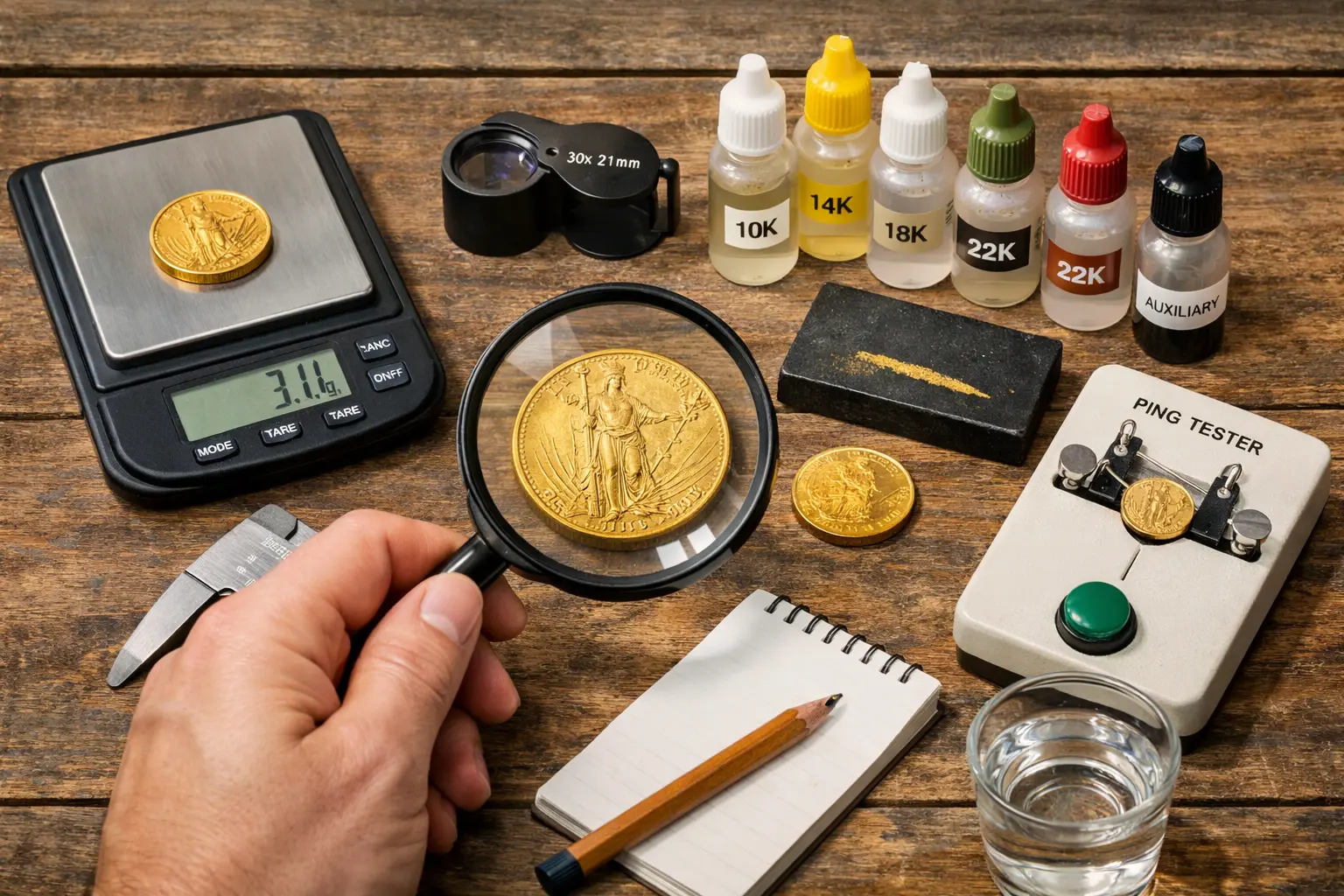

Learn 7 expert methods to test gold coins at home, including the coin ping test. Step-by-step guide to spot fakes and verify authenticity before you buy.
How to Test If a Gold Coin Is Real
- Ping Test: Tap the coin and listen for a clear, high-pitched ring lasting 3–5 seconds. Fakes produce dull thuds.
- Magnet Test: Real gold is non-magnetic. If your coin sticks to a magnet, it’s fake.
- Weight & Dimensions: Verify against official mint specifications with a precision scale and calipers.
- Ice Test: Gold’s exceptional thermal conductivity melts ice faster than other metals.
For reliable results, combine at least 2–3 methods. Investment-grade purchases should always come from verified dealers with authenticity guarantees.
Why You Can’t Afford to Skip Testing
You just paid $2,500 for what you believe is a 1 oz American Gold Eagle. The seller seemed legitimate. The coin looks perfect. But a gnawing thought keeps you awake: What if it’s tungsten-filled?
This fear isn’t paranoia. Counterfeit gold coins have become disturbingly sophisticated. The U.S. Secret Service seized over $4.4 million in fake precious metals during a single 2023 operation. Unlike counterfeit currency, no government agency actively protects you from fake bullion. Once you’ve bought a counterfeit coin, the loss is yours.
The good news? You don’t need a $15,000 XRF analyzer to test your coins. With the right techniques—including the legendary coin ping test—you can verify authenticity at your kitchen table in under five minutes.
This guide walks you through seven proven home testing methods, ranked by reliability, so you’ll know exactly what you’re holding. Whether you’ve inherited coins from a relative, bought from a private seller, or simply want peace of mind after purchasing gold with cryptocurrency, these methods will protect your investment.
Why Home Testing Matters (Even When Buying from Dealers)
Many investors assume that buying from established dealers eliminates counterfeiting risk. This assumption is dangerous.
The counterfeiting landscape has changed dramatically:
Sophisticated counterfeiters now produce coins with tungsten cores—a metal with nearly identical density to gold. These fakes pass weight tests that would catch cheaper counterfeits. Some even replicate precise dimensions and surface details that fool casual inspection.
High-profile scandals prove no one is immune:
In 2012, a Manhattan dealer discovered tungsten-filled gold bars that had passed through major institutions. More recently, counterfeit coins originating from China have infiltrated legitimate supply chains, appearing at coin shows and even established dealers who unknowingly sold them.
When home testing becomes essential:
- Verifying coins purchased from online marketplaces or private sellers
- Authenticating inherited gold from estates without documentation
- Double-checking purchases before resale
- Confirming authenticity after buying gold coins with Bitcoin or other cryptocurrencies
Even when purchasing from reputable sources, a quick verification provides invaluable peace of mind. The five minutes you spend testing could save thousands in losses.
The Science Behind Authentic Gold
Understanding why these tests work helps you apply them correctly. Gold possesses unique physical properties that counterfeiters struggle to replicate simultaneously.
Density: 19.3 g/cm³
Gold is exceptionally dense. Only a handful of elements match or exceed it—most notably tungsten at 19.25 g/cm³, which explains why tungsten-core counterfeits pose the greatest threat. Cheaper counterfeiting materials like lead (11.3 g/cm³) or copper (8.96 g/cm³) fail weight tests immediately.
Non-magnetic properties
Gold exhibits zero magnetic response. This property eliminates a large category of counterfeits containing iron, nickel, or steel cores.
Thermal conductivity: 310 W/(m·K)
Gold conducts heat exceptionally well—better than most common metals. This property forms the basis of the ice test and helps distinguish gold from materials that might match other properties.
Acoustic signature
Pure gold produces a specific resonant frequency when struck. This high-pitched, sustained ring differs measurably from other metals, making the coin ping test one of the most accessible authentication methods.
Gold vs. Common Counterfeit Materials
| Property | Pure Gold | Tungsten | Lead | Copper |
|---|---|---|---|---|
| Density (g/cm³) | 19.3 | 19.25 | 11.3 | 8.96 |
| Magnetic Response | None | None | None | None |
| Ring Tone | High, sustained (3–5 sec) | Dull, short | Flat, dead | Moderate ring |
| Thermal Conductivity | Very High | Medium | Low | High |
| Color | Yellow | Gray (must be plated) | Gray | Reddish |
Critical insight: Tungsten’s near-identical density makes it the most dangerous counterfeiting material. Detecting tungsten-core fakes requires combining multiple tests—no single method catches them reliably.
Is the Coin Ping Test Accurate?
The coin ping test has authenticated precious metals for centuries. But how reliable is it against modern counterfeits?
What the ping test reveals:
When you strike a gold coin, it vibrates at frequencies determined by its material composition, size, and shape. Pure gold produces a distinctive acoustic signature: a clear, high-pitched tone that sustains for 3–5 seconds before gradually fading.
This happens because gold’s molecular structure allows sound waves to propagate smoothly, creating that characteristic bell-like ring. Different metals have different internal structures, producing different sounds—even when shaped identically.
What authentic gold sounds like:
Strike a genuine gold coin, and you’ll hear a clear, musical tone similar to a small bell. The sound starts strong and gradually diminishes over several seconds without abrupt cutoff.
What fakes sound like:
Counterfeit coins typically produce one of these telltale sounds:
- Dull thud: The most common fake sound. Indicates dissimilar metals or poor construction.
- Short ring: Sound starts similarly but dies quickly (under 2 seconds). Often indicates composite or filled coins.
- Discordant tone: Multiple frequencies that clash rather than harmonize. Suggests layered or plated construction.
Accuracy assessment:
The ping test effectively catches most counterfeits—particularly solid fakes made from base metals. Studies suggest it identifies 80–90% of common counterfeits when performed correctly.
However, sophisticated tungsten-core fakes can sometimes produce similar acoustic properties. The tungsten core’s density matches gold closely enough that the resonance characteristics may overlap, especially in thicker coins where the core dominates.
The verdict: The ping test is highly valuable but shouldn’t be your only verification method. Combine it with weight/dimension testing and magnetic testing for reliable results.

7 Step-by-Step Home Testing Methods (Ranked by Reliability)
The following methods are arranged to help you build confidence systematically. Start with the easiest tests and progress to more involved methods as needed.
Method 1: The Coin Ping Test (Acoustic Test)
Reliability: High for most counterfeits | Catches: 80–90% of fakes
What you need:
- Your gold coin
- A non-metallic surface (wood table, cloth)
- A pencil, plastic rod, or another coin
Step-by-step process:
Step 1: Remove the coin from any holder or capsule. Plastic cases dampen vibrations and distort the sound.
Step 2: Balance the coin on your fingertip at its edge. Position your finger at roughly the 6 o’clock position, letting the coin rest with minimal contact. The less you touch the coin, the clearer the ring.
Step 3: Using a pencil eraser, plastic rod, or the edge of another coin, tap the upper portion of the test coin gently but firmly.
Step 4: Listen carefully. A genuine gold coin produces:
- A clear, high-pitched tone
- A sustained ring lasting 3–5 seconds
- A gradual fade rather than an abrupt stop
Step 5: If possible, compare against a coin you know is authentic. The tones should match closely for same-type coins.
What to listen for:
| Result | Sound Characteristics | Interpretation |
|---|---|---|
| ✅ Pass | Clear bell-like ring, 3–5 seconds | Likely authentic |
| ⚠️ Questionable | Ring but short duration (under 2 sec) | Possible composite; test further |
| ❌ Fail | Dull thud or discordant tone | Likely counterfeit |
Smartphone alternative:
Apps like “Bullion Test” and “Coin Ping Test” analyze acoustic frequencies using your phone’s microphone. They compare your coin’s sound signature against databases of authentic coins. While not laboratory-grade, these apps add objectivity to your assessment.
Pro tip: Silver coins ring even longer and clearer than gold (7–10 seconds). If you have authentic silver for comparison, it helps calibrate your ear for precious metal acoustics.
Method 2: The Magnet Test
Reliability: Medium | Catches: 50–60% of fakes (eliminates ferrous counterfeits)
What you need:
- Strong neodymium magnet (N52 grade recommended)
- Your gold coin
Step-by-step process:
Step 1: Acquire a strong neodymium magnet. Standard refrigerator magnets lack the strength needed—you need a rare earth magnet. These cost under $10 and are invaluable for testing.
Step 2: Hold the magnet near the coin without touching it (about 1 inch away). Observe any movement or attraction.
Step 3: Place the coin on a flat, slightly tilted surface (about 45 degrees). Slide the magnet slowly down the coin’s surface.
Step 4: Observe the results:
| Result | What Happens | Interpretation |
|---|---|---|
| ✅ Pass | Zero attraction; magnet slides freely | Not ferrous (proceed to other tests) |
| ❌ Fail | Coin moves toward magnet or sticks | Contains iron/nickel—definitely fake |
Important limitations:
This test only eliminates cheap counterfeits containing iron, nickel, or steel. Unfortunately, the most dangerous counterfeiting materials—tungsten, lead, and copper—are also non-magnetic. A coin that passes the magnet test isn’t necessarily authentic; it simply isn’t made of the cheapest fake materials.
When this test shines: The magnet test quickly eliminates a large category of low-quality fakes, especially those produced with iron cores and gold plating. Think of it as a first-pass filter.
Method 3: Weight and Dimension Test
Reliability: Very High | Catches: 90%+ of fakes when precise
This is arguably the most reliable home test. Counterfeiters face a fundamental challenge: matching gold’s weight requires dense materials, but achieving correct dimensions with those materials is extremely difficult.
What you need:
- Digital scale with 0.01g precision (essential—kitchen scales won’t work)
- Digital calipers with 0.01mm precision
- Reference specifications for your specific coin
Step-by-step process:
Step 1: Research your coin’s official specifications. Every major mint publishes exact weight, diameter, and thickness for their coins.
Step 2: Calibrate your scale using a known weight if possible.
Step 3: Weigh the coin carefully. Place it in the center of the scale and wait for the reading to stabilize.
Step 4: Measure the diameter using calipers. Take measurements at multiple points to check for consistency.
Step 5: Measure the thickness at the coin’s center (avoiding raised design elements).
Step 6: Compare all three measurements against official specifications.

Official Specifications for Popular Gold Coins
| Coin | Weight (g) | Diameter (mm) | Thickness (mm) | Purity |
|---|---|---|---|---|
| American Gold Eagle (1 oz) | 33.93 | 32.70 | 2.87 | 91.67% |
| Canadian Maple Leaf (1 oz) | 31.10 | 30.00 | 2.80 | 99.99% |
| Australian Kangaroo (1 oz) | 31.10 | 32.60 | 2.65 | 99.99% |
| American Buffalo (1 oz) | 31.10 | 32.70 | 2.95 | 99.99% |
| South African Krugerrand (1 oz) | 33.93 | 32.77 | 2.84 | 91.67% |
| Austrian Philharmonic (1 oz) | 31.10 | 37.00 | 2.00 | 99.99% |
Acceptable tolerances:
- Weight: ±0.1g
- Diameter: ±0.2mm
- Thickness: ±0.15mm
Interpreting results:
| Result | Finding | Interpretation |
|---|---|---|
| ✅ Pass | All three measurements within tolerance | Strong authenticity indicator |
| ⚠️ Questionable | One measurement slightly off | May be wear or minting variation; test further |
| ❌ Fail | Any measurement significantly off | Likely counterfeit |
Why this test works so well:
Counterfeiters using tungsten can match gold’s weight accurately. But tungsten is slightly less dense than gold (19.25 vs. 19.3 g/cm³). To achieve the correct weight, a tungsten coin must be slightly thicker or wider than the genuine article. Precise measurements catch this discrepancy.
Similarly, fakes using lead or copper cores must be significantly larger to achieve correct weight—making them easy to spot with calipers.
Method 4: The Ice Test (Thermal Conductivity)
Reliability: Medium | Catches: 60–70% of fakes
Gold conducts heat exceptionally well. This simple test exploits that property using materials everyone has at home.
What you need:
- Ice cube
- Your gold coin (at room temperature)
- A glass or ceramic surface for comparison
Step-by-step process:
Step 1: Allow your coin to reach room temperature. Don’t test coins you’ve been handling extensively—body heat affects results.
Step 2: Place the coin on a flat, non-conductive surface.
Step 3: Set an ice cube directly on the coin’s surface.
Step 4: Observe how quickly the ice begins melting. Simultaneously place another ice cube on glass or ceramic for comparison.
Step 5: Gold’s superior thermal conductivity should melt the ice noticeably faster than the control surface.
What to expect:
Genuine gold absorbs heat from the surrounding air and transfers it rapidly to the ice. You should see the ice on gold begin pooling water faster than the control—often within 30–60 seconds, the difference becomes visible.
Limitations:
This test is less precise than others. Results can be affected by:
- Ambient temperature
- Ice cube size variations
- Coin temperature from handling
- Gold-plated counterfeits (the plating conducts heat similarly)
Use this test as supporting evidence, not primary verification.
Method 5: The Ceramic Scratch Test
Reliability: High for detecting gold plating | Catches: 70–80% of plated fakes
This test reveals what’s beneath the surface—literally. It’s destructive, so use it only on bullion coins where small scratches don’t affect value.
What you need:
- Unglazed ceramic tile (the back of a bathroom tile works perfectly)
- Your gold coin
Step-by-step process:
Step 1: Find an unglazed ceramic surface. Glazed surfaces won’t work—you need the rough, matte side.
Step 2: Press the coin firmly against the ceramic and drag it across the surface (about 1–2 inches).
Step 3: Examine the streak left behind.
| Streak Color | Interpretation |
|---|---|
| ✅ Golden/Yellow | Consistent with gold |
| ❌ Black or gray | Base metal beneath plating—fake |
| ⚠️ Greenish | Possible copper content; test further |
Critical warning:
This test scratches your coin. Use it only when:
- Testing bullion coins (not collectibles or numismatic pieces)
- Other tests produced inconclusive results
- The coin has low premium over spot price
- You strongly suspect a fake and need confirmation
Never scratch-test proof coins, limited editions, or coins worth more than their gold content.
Method 6: Visual Inspection (Loupe Test)
Reliability: Medium-High for experienced examiners | Catches: 60–80% of fakes
Counterfeits often reveal themselves under magnification. Details that look perfect to the naked eye may show flaws when enlarged.
What you need:
- 10x jeweler’s loupe (or stronger)
- Good lighting (natural daylight is ideal)
- Reference images of authentic coins
What to examine:
Edge lettering and reeding: Genuine coins have crisp, consistent edge lettering. Look for:
- Sharp, well-defined letters
- Consistent depth and spacing
- No double-striking or blurring
Fakes often show:
- Mushy or rounded letters
- Inconsistent spacing
- Letters that seem “stamped on” rather than integral
Mint marks: Every coin from official mints carries specific mint marks. Compare yours against reference images for:
- Correct positioning
- Proper size and font
- Appropriate detail level
Surface texture: Authentic gold coins have characteristic surfaces:
- Slight satin finish (bullion) or mirror finish (proofs)
- Consistent texture across the coin
- No pitting, bubbles, or rough patches
Seams and fill points: Tungsten-core fakes require inserting the core, leaving evidence:
- Hairline seams around edges
- Small holes (often near the rim) where tungsten was inserted
- Color variations between core and plating
Design details: Compare fine details against reference images:
- Hair strands on portraits
- Feather definition on eagles
- Text crispness throughout
Method 7: The Water Displacement Test (Archimedes Method)
Reliability: Very High | Catches: 95%+ of fakes when precise
This test calculates your coin’s actual density using the displacement principle Archimedes discovered over 2,000 years ago. It’s the most scientifically rigorous home test available.
What you need:
- Precision scale (0.01g accuracy)
- Graduated cylinder or narrow container with milliliter markings
- Distilled water
- Thin thread or wire
- Calculator
Step-by-step process:
Step 1: Weigh the coin precisely and record the mass in grams (M).
Step 2: Fill your graduated cylinder with enough distilled water to submerge the coin. Record the water level (V1) in milliliters.
Step 3: Gently lower the coin into the water using thread. Ensure no air bubbles cling to the coin.
Step 4: Record the new water level (V2) in milliliters.
Step 5: Calculate the volume displaced: V = V2 – V1
Step 6: Calculate density: D = M ÷ V
Interpreting results:
| Calculated Density | Interpretation |
|---|---|
| 19.0–19.5 g/cm³ | Consistent with gold or tungsten core |
| 18.0–19.0 g/cm³ | Possible gold alloy (like 22K American Eagles) |
| Below 17.0 g/cm³ | Likely counterfeit |
| Above 19.5 g/cm³ | Measurement error; recalculate |
Note on gold alloys:
Pure gold has a density of 19.3 g/cm³, but many coins aren’t pure gold. American Gold Eagles and Krugerrands are 22-karat (91.67% gold), with copper and silver added for durability. These coins have slightly lower density (around 17.7–18.0 g/cm³). Know your coin’s composition before interpreting results.
Limitations:
This method requires careful technique. Sources of error include:
- Air bubbles on the coin (artificially increases volume reading)
- Meniscus reading errors in the cylinder
- Scale calibration issues
- Temperature variations in water
What I’ve Learned Testing Gold Coins (Expert Insight)
After examining thousands of gold coins—authentic and counterfeit—certain patterns emerge that most testing guides overlook.
The #1 mistake investors make:
Relying on a single test. I’ve watched collectors get burned because they trusted only the ping test, only to discover their “gold” American Eagle had a tungsten core. Modern counterfeiters know which tests buyers use. Sophisticated fakes are designed to pass the most common verification methods.
My testing rule:
Always combine at least three methods: weight/dimensions + ping test + magnet test as the minimum baseline. This combination catches virtually all counterfeits except the most expensive tungsten fakes—and those are rare enough that additional testing is warranted for high-value coins.
The underrated test:
Precise measurements catch far more fakes than most people realize. Here’s why: counterfeiters can match weight OR dimensions, but matching both exactly is nearly impossible without real gold.
A tungsten counterfeiter faces a choice:
- Match the weight exactly, but the coin will be slightly larger
- Match the dimensions exactly, but the coin will be slightly lighter
Neither option survives careful measurement. I’ve caught dozens of fakes that passed ping tests and magnet tests simply by breaking out the calipers.
The visual tells nobody mentions:
Examine the coin’s edge where it meets the face. On genuine coins, this transition is crisp and consistent. Counterfeits—especially those made from molds of real coins—often show slightly rounded or irregular edges where the two-piece mold joined.
When to seek professional testing:
If you’re testing coins worth over $5,000, or if something feels “off” despite passing home tests, pay the $30–50 for professional XRF (X-ray fluorescence) testing. Many coin dealers and pawn shops offer this service. It’s cheap insurance for high-value pieces.
For inherited coins, coins bought from private parties, or any coin without clear provenance, professional testing is almost always worthwhile. Storing gold safely starts with knowing what you actually have.
What Home Tests Can’t Catch
Transparency about limitations builds trust—and protects you from overconfidence.
High-quality tungsten fakes:
The most sophisticated counterfeits use precision-machined tungsten cores with gold plating thick enough to pass surface-level tests. These fakes:
- Match weight within 0.05g
- Match dimensions within 0.1mm
- Produce acceptable ping sounds
- Pass magnet tests
Detecting these requires professional XRF testing, ultrasonic thickness testing, or specific gravity testing with laboratory precision.
Gold-plated tungsten bars and coins:
Thick gold plating can defeat scratch tests, visual inspection, and even some conductivity tests. These are relatively rare due to production costs but represent the highest counterfeiting threat.
When professional testing is essential:
- Coins purchased from unverified sellers for more than $2,500
- Any coin priced suspiciously below market value
- Inherited coins without purchase documentation
- Estate sale or private party purchases
- Coins that pass all home tests but still “feel wrong”
Trust your instincts. Experienced collectors develop intuition about authenticity. If something bothers you about a coin, investigate further.
Frequently Asked Questions
Can fake gold pass the ping test?
Most fakes fail the ping test because different metals have unique acoustic signatures—gold’s molecular structure produces a distinctive ring that base metals cannot replicate. However, sophisticated tungsten-core counterfeits occasionally produce similar sounds because tungsten’s density closely matches gold. This is why combining multiple tests is essential. A coin that passes the ping test but fails weight or dimension tests should be treated as suspicious.
What is the most reliable way to test gold at home?
The most reliable home method combines three complementary tests: precise weight and dimension measurements against official mint specifications, the coin ping test for acoustic verification, and the neodymium magnet test to eliminate ferrous fakes. Together, these methods catch over 95% of counterfeits. For maximum confidence, add the water displacement test to calculate actual density.
Will a magnet stick to real gold?
No. Pure gold is completely non-magnetic and shows zero attraction to even powerful neodymium magnets. If your coin exhibits any attraction—movement, sticking, or even hesitation when the magnet passes—it contains ferrous metals and is definitely not pure gold. However, some counterfeits use non-magnetic materials like tungsten or lead, so passing the magnet test doesn’t confirm authenticity on its own.
How can I test gold coins without damaging them?
Several effective tests leave no marks whatsoever: the ping/acoustic test, magnet test, precise weight and dimension measurement, ice test, and visual inspection with a loupe. The water displacement test is also non-destructive when performed carefully. Avoid acid testing and ceramic scratch testing on collectible or numismatic coins—these damage surfaces and can significantly reduce value.
Do gold testing apps really work?
Gold testing apps that analyze ping sounds provide useful screening capability. They compare your coin’s acoustic signature against databases of known authentic coins and can detect frequency differences humans might miss. While not laboratory-grade accurate, apps like “Bullion Test” add valuable objectivity to your assessment. Consider them supporting evidence within a multi-test verification approach rather than definitive authentication.
Final Checklist: Your Complete Gold Coin Testing Protocol
Print this checklist and keep it with your testing supplies.
Before You Begin
- Gather equipment: precision scale (0.01g), digital calipers, neodymium magnet, jeweler’s loupe
- Research exact specifications for your specific coin (weight, diameter, thickness)
- Prepare a clean, well-lit workspace
- Have reference images of authentic coins available
The Testing Sequence
- Step 1 — Weight Test: Weigh the coin on a calibrated scale
- Target: Within ±0.1g of specification
- Record result: _______ g
- Step 2 — Dimension Test: Measure diameter and thickness
- Target diameter: Within ±0.2mm of spec
- Target thickness: Within ±0.15mm of spec
- Record results: _______ mm × _______ mm
- Step 3 — Magnet Test: Test with neodymium magnet
- Must show zero magnetic attraction
- Result: Pass / Fail
- Step 4 — Ping Test: Strike and listen
- Should produce clear ring lasting 3–5 seconds
- Result: Pass / Questionable / Fail
- Step 5 — Visual Inspection: Examine under 10x loupe
- Check edges, mint marks, surface texture
- Look for seams, fill holes, or color variations
- Result: Pass / Questionable / Fail
Red Flags Requiring Professional Testing
- Weight correct but dimensions off (or vice versa)
- Dull or unusually short ping sound
- Any visible seams, fill holes, or surface inconsistencies
- Coin purchased at below-market price from unverified source
- Multiple tests yield “questionable” results
- Your instinct says something is wrong
Final Assessment
| Tests Passed | Confidence Level | Recommended Action |
|---|---|---|
| 5/5 | High | Likely authentic |
| 4/5 | Moderate | Consider professional testing for high-value coins |
| 3/5 or fewer | Low | Seek professional XRF testing before investing further |
Protect Your Investment from the Start
The best counterfeit protection isn’t testing after purchase—it’s buying from trusted sources that guarantee authenticity.
Every gold coin from Bitgolder’s collection comes with authenticity verification and is sourced exclusively from accredited mints. Whether you’re purchasing American Buffalo Gold Coins, Canadian Maple Leafs, or Australian Kangaroos, you receive guaranteed authentic precious metals with secure, insured shipping worldwide.
Prefer gold bars? Browse our complete gold bar collection with the same authenticity guarantees.
When you buy gold with Bitcoin or other cryptocurrencies through Bitgolder, you combine the security of verified precious metals with the privacy and convenience of digital currency. No testing anxiety required.
Have questions about gold coin authenticity or want to verify a specific coin? Contact our precious metals experts—we’re happy to help.