
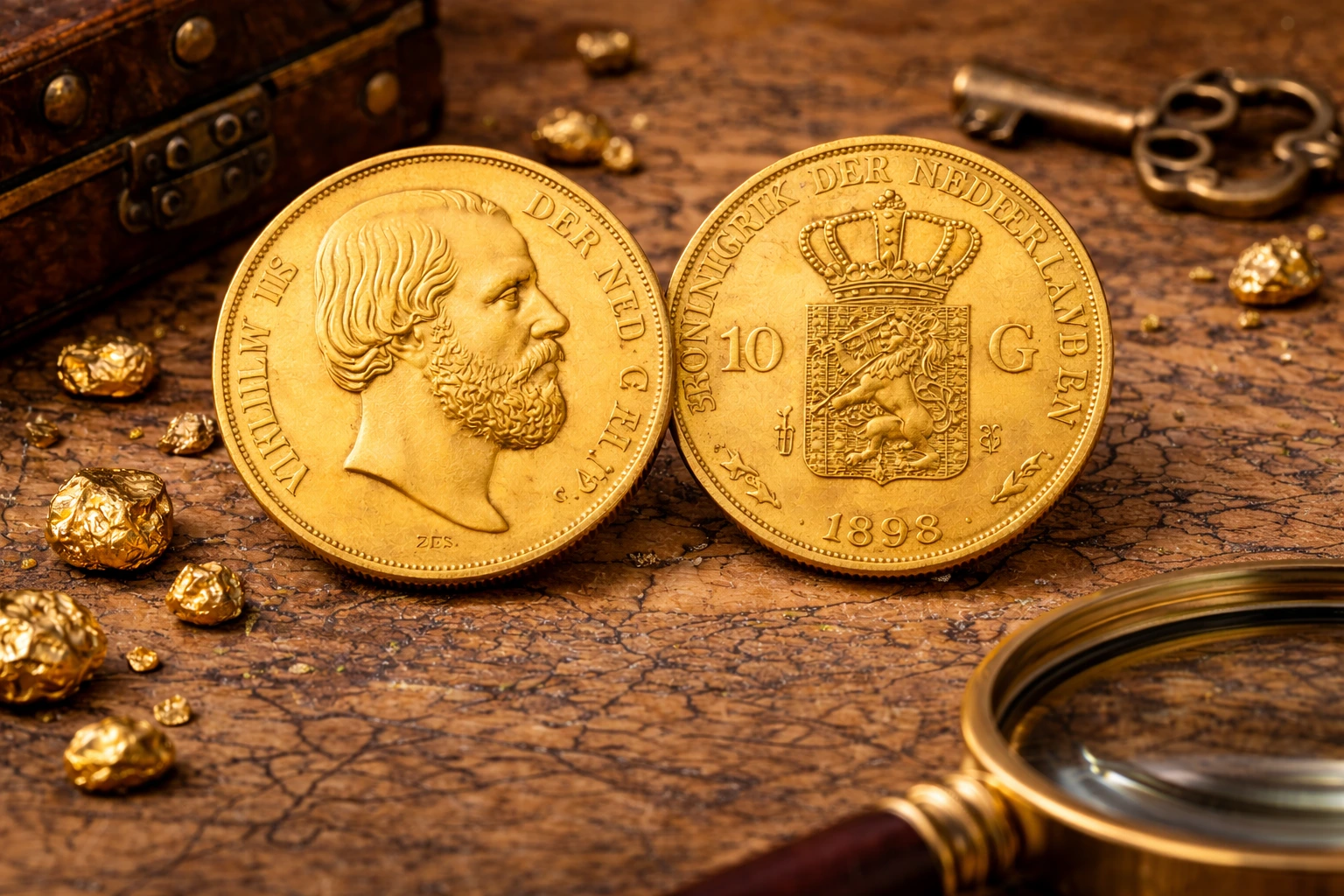

Dutch gold coins trade at remarkably low premiums despite their scarcity—often matching prices of common European 20 Franc coins while delivering superior historical significance.
Why Smart Investors Choose Dutch Gold
Here’s a secret the big dealers won’t advertise: Dutch gold coins consistently rank among the best values in European numismatics.
Consider the 10 Guilder. This gorgeous coin contains MORE gold than a French 20 Franc or Swiss Helvetia. It features stunning royal portraits spanning four monarchs. And it typically trades at virtually the same price as those far more common coins.
That’s not a pricing error—it’s an opportunity.
The Netherlands dominated global trade for centuries. Amsterdam served as the world’s financial capital. Dutch coins circulated from Manhattan to Jakarta. Yet today, these historic treasures fly under the radar while investors chase overpriced modern bullion.
This guide reveals everything about Dutch gold and silver coins: the legendary Ducats that financed empires, the beautiful Guilders featuring Dutch royalty, and the iconic Lion Dollars that gave America its currency name. Whether you’re buying gold with Bitcoin or traditional methods, Dutch coins deserve your attention.
The Golden Age: Dutch Coins That Built an Empire
A Trading Superpower’s Currency
During the 17th century—the Dutch Golden Age—the Netherlands became Earth’s wealthiest nation per capita. The Dutch East India Company (VOC) operated history’s first multinational corporation. Amsterdam’s Wisselbank pioneered modern central banking.
This economic dominance required trusted currency. Dutch coins became the gold standard (literally) for international trade. From Scandinavia to Indonesia, merchants preferred Dutch gold for one simple reason: absolute reliability.
Key historical milestones:
- 1586: Gold Ducat established in Dutch coinage law
- 1609: Bank of Amsterdam founded, stabilizing Dutch currency
- 1680: Silver Guilder standardized across provinces
- 1818: First Gold 10 Guilder minted under King Willem I
- 1933: Last circulation Guilders struck under Queen Wilhelmina
The Lion Dollar’s American Connection
Here’s a fascinating fact: the word “dollar” comes from Dutch.
The Leeuwendaalder (Lion Dollar), first minted in 1575, circulated extensively in Colonial America. Dutch colonists brought these coins to New Amsterdam—later renamed New York. The pronunciation evolved: daalder became “dollar.”
The Lion Dollar appears fourth in the official U.S. Red Book of coins, recognized as one of America’s first silver dollars. When you hold a Lion Dollar, you’re touching the direct ancestor of today’s U.S. currency.
Gold 10 Guilder: The Crown Jewel
The Gouden Tientje (Golden Tenner) represents Dutch coinage at its finest.
Specifications
| Detail | Value |
|---|---|
| Years Minted | 1818-1933 |
| Total Weight | 6.72 grams |
| Pure Gold | 6.048 grams (0.1947 oz) |
| Purity | 90% (21.6 karat) |
| Diameter | 22.5mm |
| Thickness | 1.3mm |
| Mintage | 50+ million total |
Four Monarchs, Four Designs
The 10 Guilder series spans four successive rulers, each with distinctive portraits:
King Willem I (1818-1840) The first 10 Guilders featured the founder of the modern Dutch Kingdom. These earliest coins are scarcer and command modest collector premiums.
King Willem II (1840-1849) A shorter reign means fewer coins. Willem II 10 Guilders are genuinely rare—serious collectors pursue these actively.
King Willem III (1849-1890) The longest-ruling Dutch King produced substantial 10 Guilder quantities. These offer excellent value for bullion-focused buyers.
Queen Wilhelmina (1890-1933) Wilhelmina’s remarkable 58-year reign produced the most common 10 Guilders. Her portrait evolved across three distinct design periods:
- 1892-1897: Young Wilhelmina (child portrait)
- 1898-1911: “Crowned Head” (mature portrait with crown)
- 1912-1933: “Older Head” (final portrait, 12 million minted)
Why 10 Guilders Offer Exceptional Value
Compare the 10 Guilder to similar European gold coins:
| Coin | Gold Content | Typical Premium |
|---|---|---|
| Dutch 10 Guilder | 0.1947 oz | Low-Moderate |
| French 20 Franc | 0.1867 oz | Low-Moderate |
| Swiss 20 Franc | 0.1867 oz | Low-Moderate |
| British Sovereign | 0.2354 oz | Moderate-High |
The 10 Guilder contains 4% more gold than French and Swiss coins yet often trades at identical prices. This value gap exists because American dealers stock fewer Dutch coins—lower demand keeps premiums suppressed.
For value-conscious investors, this represents a genuine arbitrage opportunity.
The Gold Ducat: 400 Years of Trust
Since 1586, the Dutch Gold Ducat has remained virtually unchanged—one of history’s most consistent coin designs.
Specifications
| Detail | Single Ducat | Double Ducat |
|---|---|---|
| First Minted | 1586 | 1612 |
| Total Weight | 3.494g | 6.988g |
| Pure Gold | 3.434g (0.110 oz) | 6.868g (0.221 oz) |
| Purity | 98.3% (23.6k) | 98.3% (23.6k) |
| Diameter | 21mm | 26mm |
| Thickness | 0.7mm | 0.7mm |
The Knight and His Arrows
The Ducat’s obverse has remained essentially unchanged for over four centuries:
A standing knight in armor holds a sword over his right shoulder. In his left hand, he grasps a bundle of seven arrows—symbolizing the unity of the Dutch provinces.
The Latin inscription reads: “CONCORDIA RES PARVAE CRESCUNT” Translation: “Unity makes small things grow”
This motto, adopted by the Republic of the Seven United Netherlands in 1588, still resonates today.
Why Ducats Matter
The Gold Ducat served as international trade currency for centuries:
- Accepted throughout Scandinavia, Poland, and Russia
- Standard payment in Asian VOC trade
- So trusted that other nations counterfeited the design
Modern Ducats: The Royal Dutch Mint continues striking Gold Ducats annually in proof quality. The 2025 edition features coffee beans—honoring Dutch history as Europe’s first commercial coffee trader.

Investment Considerations
Advantages:
- Exceptionally high purity (98.3%)
- Centuries of continuous production
- Instantly recognizable worldwide
- Still minted by Royal Dutch Mint
Considerations:
- Small size (3.49g) means higher per-gram premiums
- Thin profile (0.7mm) requires careful handling
- Modern proofs carry collector premiums over bullion
Gold 5 Guilder: The Affordable Entry Point
For investors wanting Dutch gold at lower cost, the 5 Guilder delivers.
Specifications
| Detail | Value |
|---|---|
| Years Minted | 1826-1912 |
| Total Weight | 3.364 grams |
| Pure Gold | 3.02 grams (0.097 oz) |
| Purity | 90% (21.6 karat) |
| Diameter | 18mm |
Design Features
The 5 Guilder mirrors the 10 Guilder design in smaller format:
- Obverse: Portrait of reigning Dutch monarch
- Reverse: Royal coat of arms with crowned Dutch lion
- Edge: Inscribed with “GOD ZIJ MET ONS” (God Be With Us)
Investment Value
The 5 Guilder contains roughly half the gold of a 10 Guilder at proportionally lower cost. These coins suit:
- Budget-conscious investors building positions gradually
- Collectors completing Dutch royal portrait sets
- Those wanting fractional gold for potential barter scenarios
Dutch Silver: Lion Dollars & Rijksdaalders
Dutch silver coins carry historical weight that rivals their gold counterparts.
The Lion Dollar (Leeuwendaalder)
Historical Significance:
- First minted 1575 during Dutch independence struggle
- Circulated globally as preferred trade currency
- Direct ancestor of the American dollar
- Fourth coin listed in U.S. Red Book
Original Specifications:
- Weight: 27.68 grams
- Purity: 75% fine silver
- Diameter: ~40mm
Modern Restrikes: The Royal Dutch Mint produces official Lion Dollar restrikes:
- 1 troy ounce (31.1g) in .999 fine silver
- Proof quality with full design detail
- Wooden presentation cases available
These restrikes offer affordable entry to Lion Dollar ownership without hunting rare originals.
The Silver Ducat (Rijksdaalder)
The silver counterpart to the Gold Ducat:
- Also features standing knight design
- Still minted annually by Royal Dutch Mint
- Contains approximately 28g of fine silver
The Guilder Series
Silver Guilders circulated extensively until the Euro transition in 2002:
- Rijksdaalder: 2.5 Guilders, 25g, 94.5% silver (Willem I-III era)
- Gulden: 1 Guilder, various silver contents by era
- Smaller denominations: 25, 10, and 5 cent pieces
How to Authenticate Dutch Coins
Dutch gold coins face counterfeiting attempts. Here’s how to verify authenticity.
Weight and Dimension Check
Your primary defense:
| Coin | Weight | Diameter | Thickness |
|---|---|---|---|
| 10 Guilder | 6.72g (±0.03g) | 22.5mm | 1.3mm |
| 5 Guilder | 3.36g (±0.02g) | 18mm | 1.1mm |
| Gold Ducat | 3.49g (±0.02g) | 21mm | 0.7mm |
Use precision scales (0.01g accuracy) and digital calipers. Matching all three measurements simultaneously challenges counterfeiters significantly.
The Ping Test
22-karat alloy coins (Guilders) produce distinctive, sustained rings when struck—excellent for acoustic testing.
Ducats at 98.3% purity ring more softly. The test works but requires calibrated expectations.
For detailed testing methods, see our gold coin authentication guide.
Visual Inspection
Examine under 10x magnification:
Portrait quality:
- Sharp hair detail on royal portraits
- Clear facial features without mushiness
- Crisp lettering on inscriptions
Coat of arms:
- Individual scales visible on lion
- Crown detail properly defined
- Motto text legible
Edge characteristics:
- Reeded edges uniform
- No seams or join lines
- “GOD ZIJ MET ONS” clearly inscribed (Guilders)
Red Flags
Watch for:
- Weight correct but dimensions wrong (or vice versa)
- Blurry portrait details
- Uneven color or suspicious patina
- Prices dramatically below market
Where to Buy Dutch Gold Coins
Major Dealers
Dutch coins appear at most reputable precious metals dealers:
- APMEX
- JM Bullion
- Money Metals Exchange
- Provident Metals
Note: Inventory varies. Dutch coins are scarcer than French or Swiss gold, so availability fluctuates.
European Sources
For larger selections:
- The Silver Mountain (Netherlands)
- Bitgild (Netherlands)
- Holland Gold (Netherlands)
European dealers often carry broader Dutch coin inventories at competitive premiums.
Buying with Cryptocurrency
BitGolder offers authenticated European gold coins for cryptocurrency purchase. Benefits include:
- Bitcoin, Ethereum, and stablecoin payments
- Anonymous purchases up to $20,000
- Worldwide insured shipping
- Authenticity verification included
Dutch Coins vs. Other European Gold
How do Dutch coins compare to alternatives?
Dutch 10 Guilder vs. French 20 Franc
| Factor | Dutch 10 Guilder | French 20 Franc |
|---|---|---|
| Gold Content | 0.1947 oz | 0.1867 oz |
| Purity | 90% | 90% |
| Typical Premium | Low | Low |
| Availability | Moderate | High |
| Design Variety | 4 monarchs | Multiple designs |
Verdict: 10 Guilders offer 4% more gold at similar prices—clear value advantage.
Dutch 10 Guilder vs. British Sovereign
| Factor | Dutch 10 Guilder | British Sovereign |
|---|---|---|
| Gold Content | 0.1947 oz | 0.2354 oz |
| Purity | 90% | 91.67% |
| Typical Premium | Low | Higher |
| Recognition | Moderate | Very High |
Verdict: Sovereigns contain more gold but command higher premiums. 10 Guilders often deliver better value per dollar spent.
Gold Ducat vs. Austrian Ducat
| Factor | Dutch Ducat | Austrian Ducat |
|---|---|---|
| Gold Content | 0.110 oz | 0.1106 oz |
| Purity | 98.3% | 98.6% |
| Design | Knight (unchanged since 1586) | Emperor Franz Joseph |
| Premium | Moderate | Moderate |
Verdict: Nearly identical specifications. Choose based on historical preference or availability.
Building a Dutch Coin Collection
Strategy 1: Bullion-Focused
Prioritize gold content per dollar:
- 10 Guilders (any monarch) for best value
- 5 Guilders for smaller purchases
- Avoid proof Ducats (collector premiums)
Strategy 2: Collector-Focused
Build historical sets:
- One 10 Guilder from each monarch (Willem I, II, III, Wilhelmina)
- Single and Double Gold Ducats
- Lion Dollar restrike for American history connection
Strategy 3: Complete Dutch Gold
For serious collectors:
- All four monarch 10 Guilders
- Multiple Wilhelmina portrait varieties
- Gold Ducats (historic and modern)
- 5 Guilders from available years
Frequently Asked Questions
Are Dutch gold coins a good investment?
Dutch gold coins offer exceptional value for informed investors. The 10 Guilder contains more gold than comparable European coins yet trades at similar premiums. Their relative scarcity in American markets means lower collector competition—you’re paying primarily for gold content rather than numismatic markup. For pure bullion value, few European coins match Dutch offerings.
Why are Dutch coins less expensive than other European gold?
Supply and demand dynamics favor buyers. American dealers stock fewer Dutch coins, so less marketing drives their prices. Meanwhile, European 20 Franc coins (French, Swiss, Belgian) dominate the “European gold” category in U.S. markets. This creates an arbitrage opportunity: Dutch coins offer equal or superior gold content at comparable prices.
What’s the best Dutch gold coin for beginners?
The 10 Guilder (Gouden Tientje) makes an ideal starting point. It offers substantial gold content (0.1947 oz), competitive pricing, and beautiful designs featuring Dutch royalty. Queen Wilhelmina 10 Guilders from 1912-1933 are most common and affordable, providing excellent bullion value without collector premiums.
Are Dutch gold coins IRA eligible?
Most Dutch gold coins meet IRA purity requirements. The Gold Ducat at 98.3% purity and 10 Guilder at 90% purity typically qualify. However, confirm eligibility with your specific IRA custodian before purchasing, as requirements vary.
Where does the word “dollar” come from?
The American dollar derives its name from the Dutch daalder (or German thaler). Dutch Lion Dollars (Leeuwendaalder) circulated extensively in Colonial America, particularly in New Amsterdam (New York). The pronunciation evolved from “daalder” to “dollar”—making Dutch coinage the direct linguistic ancestor of U.S. currency.
Key Takeaways
Dutch gold coins represent one of the precious metals market’s best-kept secrets—offering substantial historical significance and competitive pricing that savvy investors increasingly recognize.
- 10 Guilders contain 4% more gold than French or Swiss 20 Franc coins yet typically trade at identical prices—genuine value for bullion buyers
- Gold Ducats feature unchanged designs since 1586, making them among history’s most consistent coins—trusted worldwide for over 400 years
- The Lion Dollar gave America its currency name—Dutch daalder evolved into “dollar” through Colonial American usage
- Lower American demand creates opportunity—fewer collectors competing means you pay for gold content rather than numismatic premiums
- Royal Dutch Mint continues production—modern Ducats and Lion Dollar restrikes available annually in proof quality
- 90% purity (Guilders) and 98.3% purity (Ducats) both meet most IRA requirements—verify with your custodian
For investors seeking European gold without European premiums, Dutch coins deliver history, beauty, and value that few alternatives match.
Ready to Add Dutch Gold to Your Collection?
Explore BitGolder’s European gold selection for authenticated Dutch coins and other premium bullion. Purchase with Bitcoin, Ethereum, or traditional payment—all orders include verification and insured worldwide shipping.
Looking for other historic European gold? Browse our complete gold coin collection featuring coins from major world mints.
Questions about Dutch coins or cryptocurrency purchases? Contact our team—we’re here to help.